

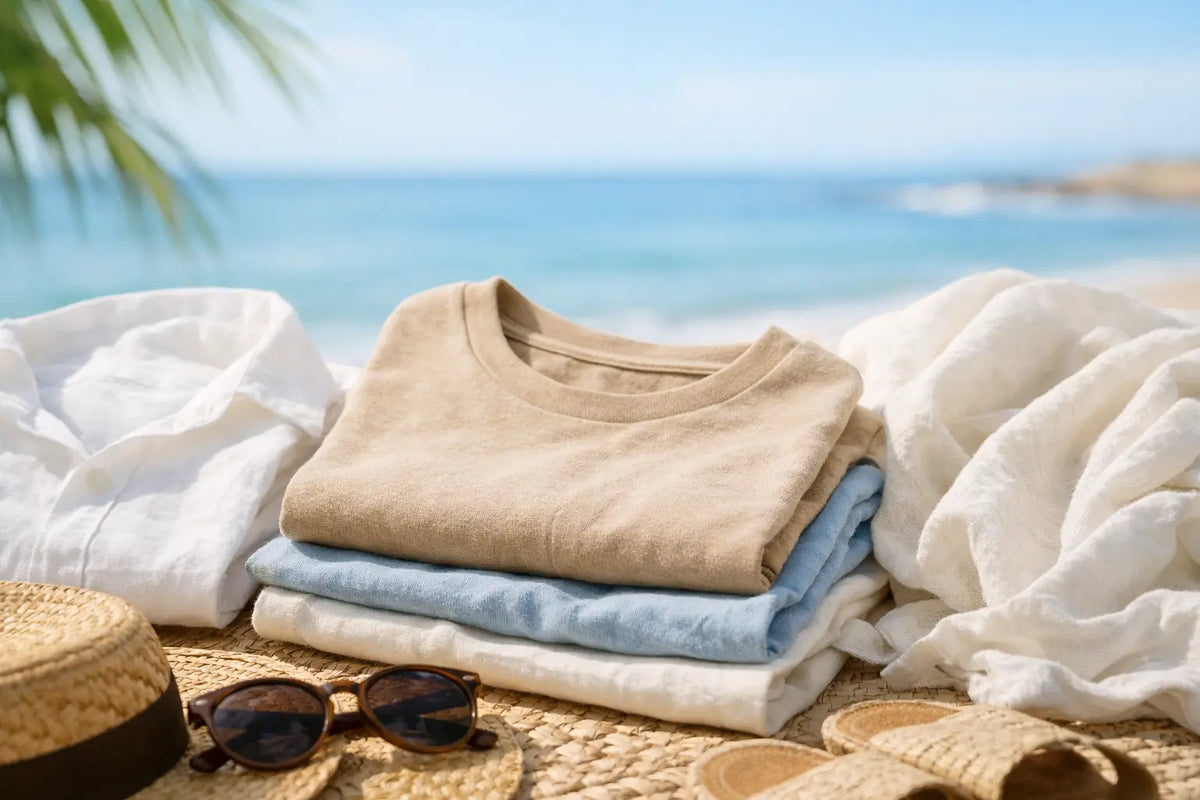
A good summer T-shirt should not feel like a compromise. It should be light without turning sheer, breathable without losing its shape, and comfortable after the tenth wash, not just the first. The best fabrics for summer basics do that work quietly. They manage heat, move with you, and stand up to everyday wear.
Fabric is only one part of a reliable essential. Weight, knit, construction, and fit matter just as much. Still, the fiber choice sets the foundation. If your warm-weather rotation is built around tees, polos, and easy layers, these are the materials worth understanding.
What Makes a Fabric Work in Summer?
Summer comfort is not simply about wearing the thinnest possible fabric. Very lightweight material can feel cool for a moment, then cling to the body, show sweat, or wear out too quickly. A better summer basic balances airflow with enough structure to hold its fit.
Look for fabrics that let moisture move away from the skin and allow air to circulate. Natural fibers tend to do this well, though the result depends on how the garment is knit or woven. A loose linen weave behaves differently from a dense cotton jersey, even when both are breathable.
Durability matters, too. The shirt you reach for every hot morning needs to recover after washing, keep its collar in order, and resist that stretched-out look. The right fabric should make getting dressed easier, not add another item to replace next season.
The Best Fabrics for Summer Basics
Cotton: The dependable everyday choice
Cotton remains the standard for summer T-shirts for a reason. It is soft, breathable, easy to care for, and familiar from the first wear. In a well-made jersey, cotton has enough body to sit cleanly on the shoulders and chest while still feeling comfortable against warm skin.
For everyday basics, fabric quality matters more than a broad label like “100% cotton.” Longer fibers generally create a smoother, stronger yarn with less surface fuzz. A tighter, even knit can also help a tee keep its shape through repeated washing. These details are less flashy than a seasonal print, but they are what separate a useful T-shirt from a disposable one.
Cotton does absorb moisture, which is both its strength and its limitation. It feels dry and natural in normal heat, but can stay damp during very humid days or high-intensity activity. For errands, commuting, travel, and daily wear, that is rarely a dealbreaker. For a hard workout, a technical fabric may make more sense.
The weight of the cotton also changes the experience. A featherlight tee can be excellent in extreme heat, but a midweight cotton jersey often offers more coverage, a better drape, and a longer life. The goal is not the lightest shirt. It is the one you will keep wearing.
Linen: Maximum airflow, relaxed structure
Linen earns its place when heat and humidity are at their worst. Its fibers allow air to pass through easily, and its naturally textured surface sits slightly away from the skin rather than clinging to it. That is why a linen shirt can feel noticeably cooler than a dense cotton shirt in the same temperature.
The trade-off is obvious: linen wrinkles. That is part of the fabric’s character, not a defect. A linen button-up will not stay as crisp as a cotton poplin shirt after hours of sitting, walking, or traveling. If a perfectly smooth appearance is essential, linen may not be your first choice.
For casual shirts, relaxed polos, and vacation layers, those wrinkles are often worth it. Linen has visual texture, breathes exceptionally well, and gets softer with use. Just expect a more laid-back finish than you would get from a structured cotton basic.
Cotton-linen blends: A practical middle ground
A cotton-linen blend is often the answer for people who like linen’s cool feel but want less wrinkling and more familiar softness. Cotton gives the fabric a smoother hand and a bit more structure. Linen keeps it airy and dry-feeling.
This blend works especially well for polos, overshirts, and elevated casual tees. It will not perform exactly like pure linen in peak humidity, but it is usually easier to wear day to day. It also tends to look more composed by late afternoon.
As always, the blend ratio matters. A small amount of linen may add texture without dramatically changing performance. A higher linen content delivers more airflow but brings you closer to the wrinkle profile of pure linen. Neither is automatically better. Choose based on where and how you plan to wear it.
Lyocell blends: Smooth, soft, and moisture-aware
Lyocell is a cellulosic fiber made from wood pulp. In clothing, it is valued for its smooth finish, soft feel, and ability to handle moisture comfortably. Blended with cotton, it can make a summer tee or polo feel cooler and silkier without looking delicate.
This is a strong option if standard cotton sometimes feels rough or heavy to you. Lyocell blends often drape well, making them suited to clean, refined basics that still feel easy. They can be particularly useful for fitted styles because the fabric moves smoothly rather than fighting the body.
There are trade-offs. A very soft, fluid blend may not have the firm structure of a dense all-cotton jersey. Quality construction matters here. Look for a garment that has enough recovery at the collar, shoulders, and hem to avoid looking tired after a few wears.
Small amounts of stretch: Useful when controlled
A little elastane can improve movement and shape retention in a slim-fit tee or polo. It helps the fabric return to form after wear, which is useful when you want a closer silhouette without a restrictive feel.
More stretch is not always better. High-stretch fabrics can trap heat, develop odor faster, or lose their clean hand over time. For everyday summer basics, a small percentage is usually enough. The fabric should still feel like cotton or a natural-fiber blend, not like activewear.
Match the Fabric to the Basic
For a classic crew neck or V-neck T-shirt, quality cotton is hard to beat. It is versatile, easy to wash, and works across most summer days. Choose a lighter jersey if you run warm, or a more substantial knit if you prefer a sharper silhouette and better coverage.
For slim-fit tees, cotton with a controlled amount of stretch can offer a cleaner fit through the chest and arms. For long-fit tees, fabric recovery is especially important. Extra length is useful only when the hem does not twist, shrink excessively, or lose its line after a wash cycle.
Polos benefit from texture. Cotton piqué is a proven choice because its knit structure promotes airflow while keeping the collar and placket looking defined. For a more relaxed warm-weather option, cotton-linen blends offer a lighter, more casual feel.
Do not overlook color. Light shades reflect more heat, but they can be more revealing in thin fabrics. White, pale gray, and light blue work best when the fabric has enough density to provide coverage. Darker colors absorb more heat, yet a breathable, well-built dark tee can still be more comfortable than a flimsy light one.
Fabric Care Is Part of Longevity
Even the right fabric needs sensible care. Wash basics in cold water, avoid overloading the machine, and use a moderate amount of detergent. High heat is tough on cotton fibers, elastic components, and collars, so air-drying or using low heat will help preserve fit.
Linen can be washed regularly, but it benefits from being removed promptly and reshaped while damp. Cotton-linen and lyocell blends should be treated with similar care. The goal is simple: reduce unnecessary stress on the fabric so the garment keeps doing its job.
The best summer wardrobe is not built from the most items. It is built from a few dependable pieces in fabrics that suit your climate, fit, and routine. Start with a well-made cotton tee, add linen when the heat calls for it, and choose blends where their practical benefits fit your day. Comfort should hold up longer than one season.


Hinterlasse einen Kommentar
Diese Website ist durch hCaptcha geschützt und es gelten die allgemeinen Geschäftsbedingungen und Datenschutzbestimmungen von hCaptcha.