

A T-shirt that keeps riding up out of your trousers, ends too high at the waist, or shrinks even shorter after the first wash isn't a minor detail for tall men — it's just plain annoying. The question of which T-shirts are suitable for tall men is therefore not just about style, but above all about proportion, comfort, and longevity.
Which T-Shirts Are Suitable for Tall Men?
The short answer: T-shirts with extra body length, a balanced shoulder line, and a fabric that holds its shape. Length alone isn't enough. Many standard shirts simply get wider in larger sizes, not longer. That gives you more volume around the stomach and chest while the hem still falls too high. That solves very little.
A good T-shirt for tall men follows the length of the body without losing shape. It should fall low enough to stay in place when moving, but not so long that it looks sloppy. That balance is what separates a shirt you wear because you have to from one you naturally reach for.
The Biggest Mistake: Sizing Up Instead of Going Longer
Many tall men know this one. Going up a size seems like the quick fix, but it usually backfires. The body gets wider, the sleeves can become bulky, and the fit loses its sharpness. You get more fabric, but not necessarily the right proportions.
Length and width are two different things. Someone who is 1.95m with a slim to average build rarely benefits from a T-shirt that mainly adds extra room at the sides. What you need is extra length in the body and often a sleeve length that's better proportioned to your upper body. That's why long fit is a more logical choice for many men than simply going XL instead of L.
What a Good T-Shirt for Tall Men Needs to Deliver
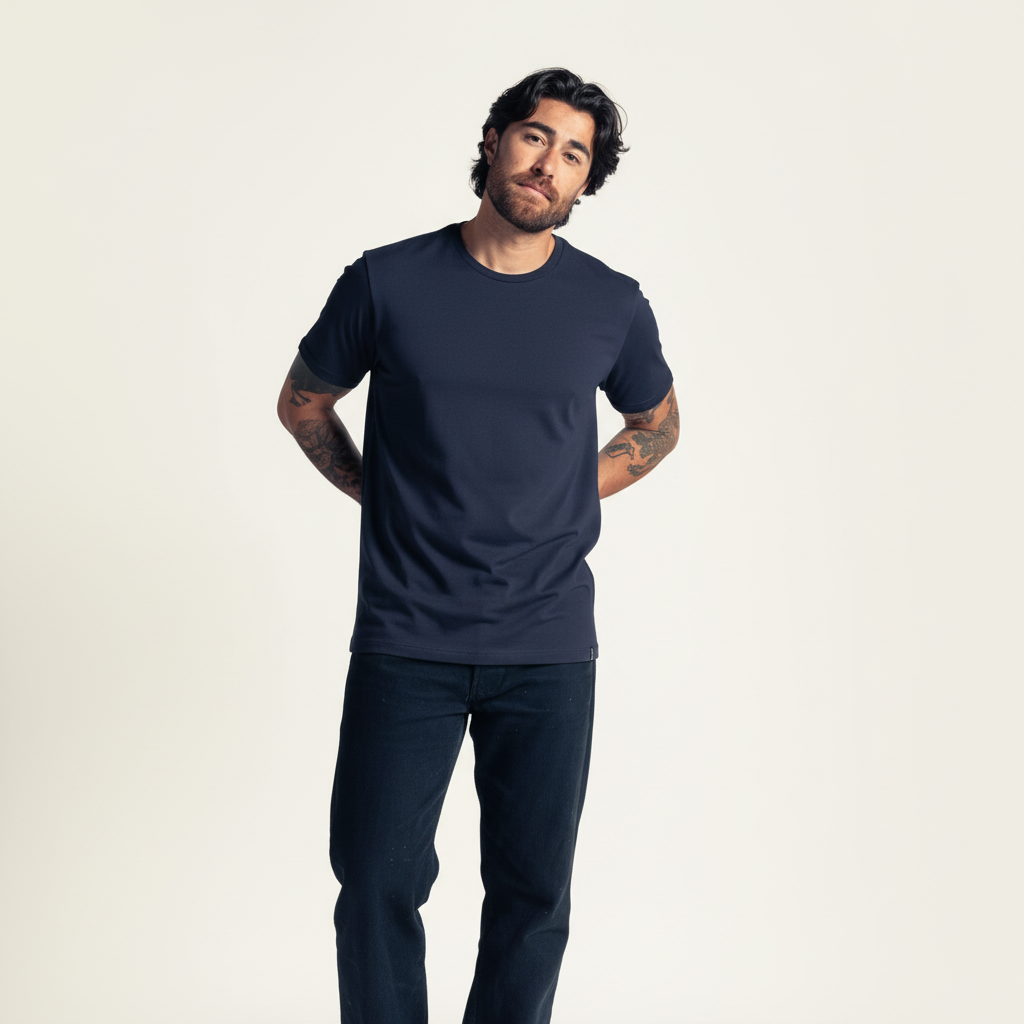
The first test is the hem. A suitable shirt doesn't end right at the waistband — it falls clearly below it. Especially when you sit, reach, or walk, you want the shirt to stay in place. Too short is immediately obvious. Not just visually, but in how often you have to tug at it.
Next comes the fit around the chest, shoulders, and waist. A long shirt still needs to have a clean line. Too tight and every movement pulls. Too loose and it quickly looks shapeless. For many tall men, a slim fit or a modern regular fit works best, depending on build. An athletic frame often needs room in the chest and shoulders with a bit more definition at the waist. A straighter build can work better in a clean, slightly less fitted silhouette.
The sleeves deserve attention too. On a poorly proportioned shirt, they can look short and cut off high, throwing the whole thing out of balance. The right sleeve falls neatly at mid-upper arm and fits without pinching.
Then there's the fabric — a point that's often underestimated. A thin, loose jersey can look fine in the fitting room but loses shape faster after washing and wearing. For tall men, that's especially inconvenient, because every centimetre of shrinkage is immediately noticeable. Opt instead for cotton of solid quality, possibly with a small percentage of stretch if you want more freedom of movement. The fabric should drape well but also have enough body to maintain the length.
Long Fit, Slim Fit, or Regular Fit?
This choice depends on your body and how you wear your T-shirts. Long fit is usually the best starting point if standard shirts are consistently too short. That doesn't automatically mean extremely long — a good long fit adds length purposefully where it's needed, without turning the shirt into a tunic.
Slim fit works well if you want a sharper, neater line and don't want excess fabric around your midsection. For tall men, slim fit often works well — as long as the shirt isn't under too much tension. Once the fabric pulls across the chest or stomach, you lose comfort and the shirt distorts faster.
Regular fit is a safe choice if you prefer a bit more room or like to wear T-shirts loosely. The advantage is comfort. The risk is that regular fit can quickly become boxy on a tall frame if the proportions aren't right. That's why regular fit is only truly strong when length has been deliberately factored into the design.
Which Neckline Works Best?
For most men, a crew neck is the most practical option. It looks clean, versatile, and sits quietly under most outfits. On a taller frame, a crew neck often helps keep the upper body visually balanced.
A V-neck can work too, especially if you have a slimmer face or a broader chest. But the V should stay modest. Too deep quickly looks cheap and makes a basic T-shirt unnecessarily busy. With essentials especially: less distraction, better foundation.
Colour and Styling: Simple Usually Works Better
When the fit is right, a T-shirt doesn't need much else. Plain colours like white, navy, black, and grey are the most versatile — especially for daily rotation. They let the fit speak and combine easily under an overshirt, jumper, or jacket.
For tall men, busy prints or exaggerated details are rarely the answer. Not because they're off-limits, but because fit is what actually solves the problem. A well-cut basic shirt in a strong fabric looks more put-together than a striking shirt that falls just a bit too short.
Watch Out for Shrinkage and Shape Retention
A T-shirt can be great at purchase and fall short after three washes. That's exactly why material and finishing matter so much. For tall men, shape retention isn't a luxury — it's a requirement. If a shirt is already on the short side, even minor shrinkage makes it unwearable.
So don't just look at how a shirt fits now — look at how it's made. Heavier cotton quality, neat finishing at the neck and hem, and a fabric that doesn't immediately twist or sag are all good signs. Care instructions matter too. Washing too hot or tumble drying almost always costs you length.
When Is a T-Shirt Actually Long Enough?
There's no universal number of centimetres that works for everyone. It depends on your height, torso ratio, and how you want to wear the shirt. Still, there's a simple practical rule: a T-shirt should stay covered and sit visually calm even when you move.
Stand up straight, raise your arms, and sit down briefly. Does the shirt immediately ride up or does the hem come dangerously close to your waist? Then it's too short. Does it hang neatly without excess fabric bunching up everywhere? Then you're good.
That's also what makes buying online tricky. Product photos often show a model of average height. What falls normally there ends up sitting very differently on a taller body. Clear information about fit, body length, and model build is therefore more valuable than just a size label.
Which T-Shirts Are Suitable for Tall Men in Daily Use?
For daily use, you want consistency above all. A shirt needs to work under a jumper, sit well on chinos, and still be reliable after frequent wear. That usually means: a premium basic with extra length, a clean neckline, a fit that follows without pinching, and a fabric that doesn't go limp.
Three things make the difference. First, a long fit base for days when you want to be sure of enough length. Second, a fabric quality that doesn't lose its shape quickly. And third, a fit that isn't trying to be fashionable — just good. That sounds simple. It is. You just don't see it often enough.
Anyone who wants to build their wardrobe practically is better off not endlessly experimenting with one-off purchases. Once you find a style that works, it makes sense to get several. Basics especially should be predictable. Less hesitation in the morning, fewer bad purchases over time.
It Also Depends on Your Build
Not every tall man has the same problem. A slim man often mainly needs extra length without extra width. Someone with broader shoulders or an athletic build also needs enough room at the top. And someone who is both tall and more solidly built usually wants a shirt that doesn't fit tight but also doesn't become tent-like.
That's why trying things on — or choosing very deliberately — still matters. The best T-shirts for tall men aren't simply the longest styles on the market. They're the ones where length, width, sleeve, and fabric are all in balance with each other.
A good basic T-shirt doesn't need to sell you a story. It just needs to fit well, stay that way, and be worn often. That's exactly where the value of a strong long-fit shirt lies — and exactly why many men ultimately choose not more fashion, but a better foundation.


Laat een reactie achter
Deze site wordt beschermd door hCaptcha en het privacybeleid en de servicevoorwaarden van hCaptcha zijn van toepassing.