

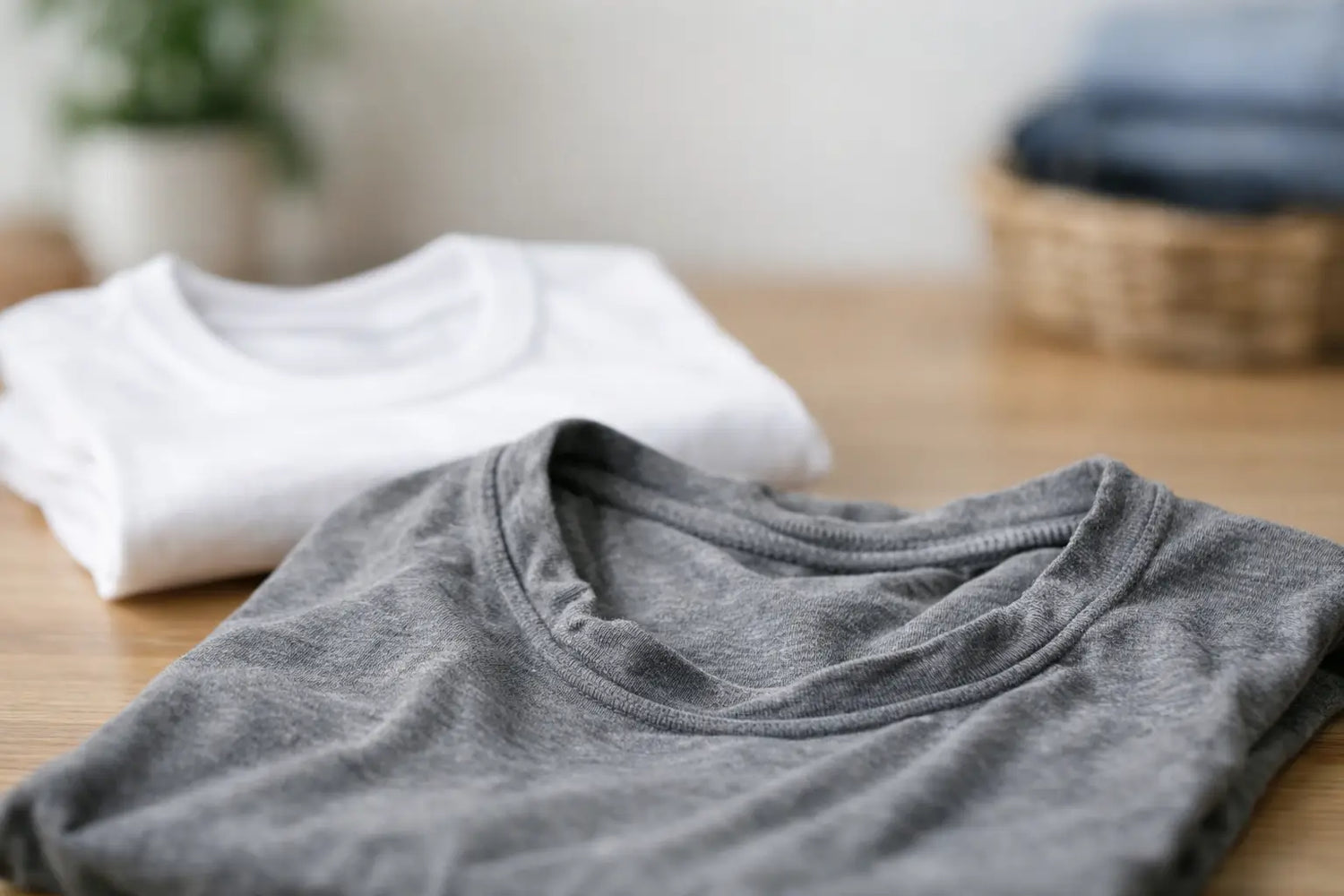
That search phrase, “waarom lubberen goedkope tshirts snel uit,” gets to a familiar frustration: a T-shirt looks fine on day one, then the collar waves, the body twists, and the hem no longer sits where it should. It is not bad luck. Most cheap T-shirts are built to hit a low price, not to hold their shape through dozens of wears and washes.
A low price does not automatically mean a bad shirt. There are honest exceptions, especially for an occasional layer or a shirt you do not expect to keep for years. But when a tee is meant to be a daily essential, the details behind the fabric matter. Yarn quality, knit density, pattern cutting, stitching, and finishing all determine whether it still feels like your T-shirt after six months.
Why cheap T-shirts lose their shape so fast
“Stretching out” is usually a combination of several failures rather than one dramatic problem. The fabric may be too loose, the fibers may not recover well, and the construction may not be stable enough to resist movement, moisture, and washing. A T-shirt is under more stress than it seems. You pull it over your head, bend your arms, sit against chair backs, wash it, spin it, and dry it. Every cycle asks the fabric to return to its original shape.
Cheap tees often struggle because their material and construction leave very little margin for that stress. The shirt may feel soft in the store, but softness alone says nothing about longevity.
Weak or short cotton fibers
Cotton fibers vary in length and strength. Longer-staple fibers can be spun into smoother, stronger yarns with fewer loose ends. Shorter fibers are less expensive, but they create yarn that is more likely to pill, thin out, and lose consistency over time.
When the yarn is weaker, the knit relaxes faster. The shirt can become wider through the chest, droop around the neck, or develop a worn, fuzzy surface after relatively few washes. This is why two 100% cotton T-shirts can feel completely different after a season. The fiber content on the label may match. The quality of the cotton and yarn does not.
A loose knit saves material, not shape
A lightweight, loosely knit fabric requires less yarn. That helps lower the cost, but it also makes the shirt more vulnerable to stretching and distortion. Pull a loose-knit tee gently sideways and you can often see the structure open up. After washing, it may not pull back evenly.
Fabric weight is not the only measure of quality. A heavier shirt can still be poorly made, and a lighter tee can be excellent when the yarn and knitting are right. Still, a well-built everyday T-shirt usually has enough density to feel stable in your hands. It should drape comfortably without becoming flimsy or transparent after a few wears.
The best test is simple: hold the fabric up to the light, stretch it lightly, then let go. If it looks overly open or stays visibly distorted, expect that behavior to increase with use.
The collar is often the first weak point
A stretched neckline makes an otherwise decent shirt look tired. On inexpensive tees, the collar rib is frequently too thin, too loose, or attached without enough reinforcement. The neck opening is one of the most stressed areas of a shirt, so this shortcut shows quickly.
A durable crew neck needs a rib that can recover after being pulled over your head. It also needs clean attachment to the body fabric, with stitching that lies flat and holds its tension. Neck tape across the back shoulder seam adds stability as well. Without these details, the collar can curl, ripple, or sag after a few laundry cycles.
This is also where fit matters. If a neck opening is already too wide for your frame, it will look stretched sooner even if the fabric itself has not failed. A precise fit makes a T-shirt look sharper for longer.
Cutting corners in construction
Fabric gets most of the attention, but construction is equally important. Cheap production often means fast cutting, minimal quality control, and seam allowances that are not as stable as they should be. That is how you end up with side seams that twist toward the front, sleeves that rotate, or a hem that looks uneven after washing.
Twisting is especially common when fabric is not properly stabilized before cutting and sewing. Cotton knit naturally wants to move. Good manufacturing accounts for that movement before the shirt reaches you. Skipping those steps saves time and money, but the result is a tee that slowly loses its original line.
Look at the side seams when trying on a T-shirt. They should run straight down the body. If they already drift or spiral, washing will not improve the situation.
Finishing can create a false first impression
Some low-cost tees feel exceptionally smooth and soft at first because of chemical finishing or aggressive softening treatments. That first touch can be persuasive, but it may disappear after the first few washes. Once the finish fades, the underlying fabric quality becomes obvious.
A better T-shirt does not need to rely on a temporary showroom feel. It should feel comfortable because the yarn is good, the knit is balanced, and the fabric has been finished with longevity in mind. It may not always feel artificially slick out of the package. It should, however, continue to feel good after repeated laundry days.
Price is not the whole story
It is fair to ask whether a more expensive T-shirt is always better. No. A higher price can reflect branding, packaging, or a trend-driven design rather than stronger materials. The point is not to buy the most expensive tee available. It is to look for evidence that the shirt was made for repeat wear.
Check the fabric composition, but do not stop there. Look at the weight and density of the knit, the firmness of the collar, the straightness of the seams, and the consistency of the cut. Read care instructions too. A T-shirt that only stays presentable with delicate treatment may not be the practical everyday basic you want.
For many people, buying fewer, better T-shirts is more economical than replacing cheap ones every few months. A three-pack of dependable tees is useful only if each shirt keeps its fit, color, and shape. That is the real value calculation.
Washing can speed up the problem
Even a well-made shirt can wear out early when it is treated roughly. Heat is the biggest accelerator. Hot water, high-heat drying, and long drying cycles weaken cotton fibers and make collars lose recovery faster. Cheap tees tend to show the damage first because they begin with less structural strength.
Wash T-shirts inside out in cool water, use a moderate spin cycle, and avoid overloading the machine. Pull them into shape while damp, especially around the collar and hem. Air drying is the gentlest option. If you use a dryer, choose low heat and remove the shirts before they are baked dry.
This will not turn a poorly made shirt into a durable one. It simply protects the quality that is there. Care extends the life of a good basic; it cannot compensate for weak yarn or loose construction.
What a T-shirt that holds up feels like
A lasting T-shirt feels stable without feeling stiff. The body keeps its line when you move. The sleeves sit where they were designed to sit. The collar returns after you pull it on. After washing, the seams remain straight and the hem does not start climbing or curling.
Fit options matter here as much as fabric. A slim-fit tee should stay close without pulling across the chest. A long-fit tee should remain long enough through the torso without turning into a loose tube. A classic fit should hang cleanly instead of expanding with every wash. LEBASQ focuses on those practical differences because a good essential should solve a daily problem, not create a new one.
The next time a cheap T-shirt feels like a bargain, look beyond the tag. A shirt that keeps its shape earns its place in your drawer one wash at a time.

Laat een reactie achter
Deze site wordt beschermd door hCaptcha en het privacybeleid en de servicevoorwaarden van hCaptcha zijn van toepassing.