


You can usually spot a good men's V-neck T-shirt straight away. Not by a big logo or a loud print, but by something simpler: the neckline sits neatly, the fabric stays taut and the shirt simply does what it should. That is exactly where it often goes wrong. The V is too deep, the fabric too thin, or the fit loses its shape after a few washes.
A V-neck is not a trend piece. It is a basic that only works if the details are right. That is why it pays to look more critically than just size and colour. Anyone who wears basics every day notices the difference between a T-shirt that looks good enough and one that is genuinely good.
Why a men's V-neck T-shirt is still relevant
The V-neck has a clear advantage over a round neck: it looks a little more open and clean. That makes it work well under a shirt, overshirt or fine-knit sweater. You are less likely to see a curling collar and the neckline stays calmer.
Worn on its own, a V-neck also has its place. Especially when the cut is slim and the neckline isn't too deep, it gives a slightly more polished effect than a standard crew neck. Not more formal, but sharper. That makes it suited to days when you want to keep it simple without looking sloppy.
At the same time, a V-neck is less forgiving. With a round neck you can still get away with mediocre finishing. With a V-neck every flaw shows. The point of the V has to sit right, the rib mustn't stretch out and the proportion between neck opening and body has to be correct. Otherwise the shirt looks cheap, even if the rest is fine.
What a good men's V-neck T-shirt has to deliver
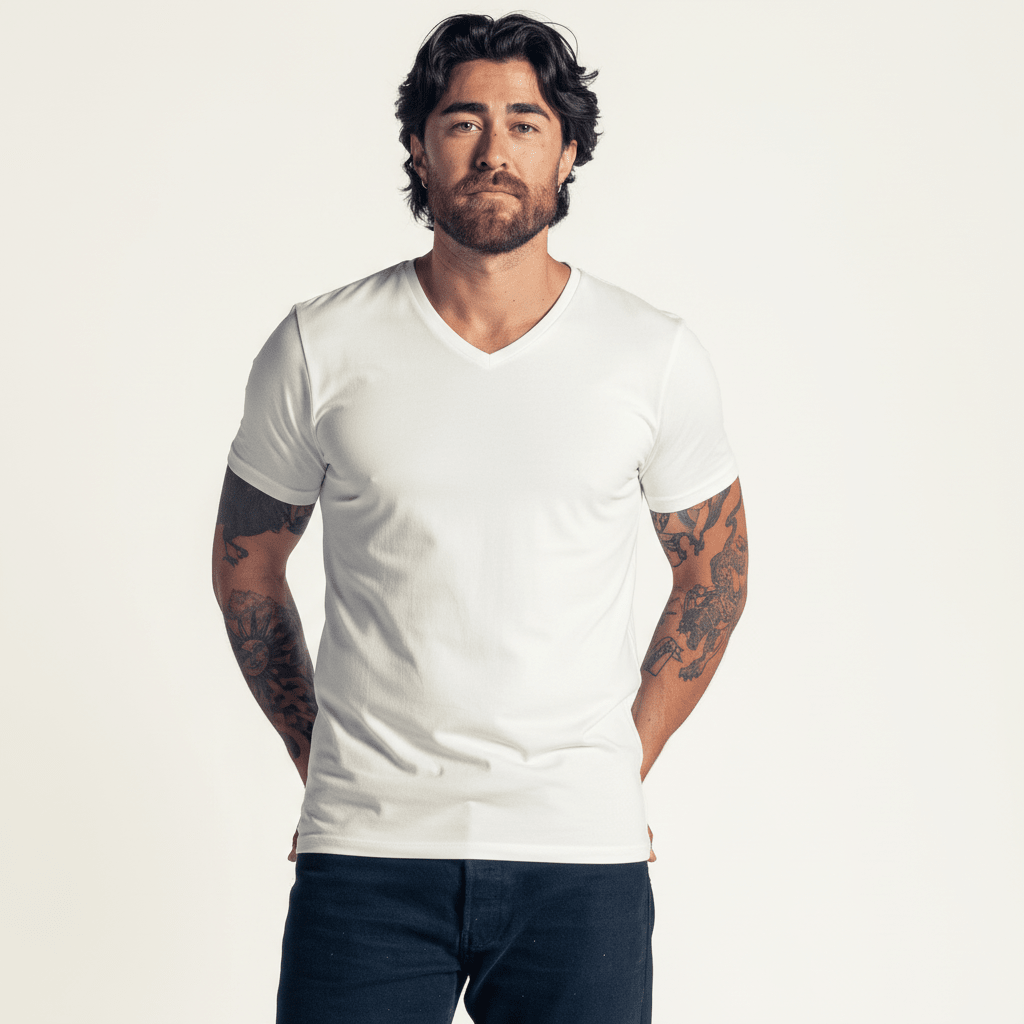
The first measure is the neckline itself. It should be subtle. A V that is too deep draws too much attention and limits what you can wear the shirt with. For everyday use, a shallow to medium V almost always works better. It makes the neck look more open without becoming a style statement.
Then comes the fabric. A premium basic should be sturdy enough to drape well, but soft enough to wear every day. A fabric that is too light can feel pleasant in the hand, but shows wear sooner and loses its shape faster. A fabric that is too heavy can feel stiff and work less well under layers. It is all about balance.
The finishing at the neckline is at least as important. A V-neck stands or falls with its construction. The seams around the point must be tight, without pulling or waves. The trim must still lie flat after many washes. If those details aren't right, the shirt quickly looks worn, even when it's still new.
The fit completes the whole. A good T-shirt follows the body without restricting it. It should sit neatly at the shoulders. Around the chest and waist you want to see shape, but no tension. And the length must be long enough to stay in place, even when you move or wear the shirt under an extra layer.
The right depth of the V-neck
There is a lot of variation here. Some men want an undershirt to disappear completely under an open shirt. Others look for a T-shirt that can be worn on its own. Those are two different functions, and the ideal neckline depth differs accordingly.
For a T-shirt worn on its own, a modest V is almost always the best choice. It looks modern and calm. For use as a layer under a shirt the V can be slightly deeper, but even then subtle is usually better than pronounced. A deep V quickly looks dated.
Fit: slim, regular or Long Fit
There is no single right fit. It depends on your build and on how you wear your basics. A slim fit works well if you want a sharp silhouette and often wear the shirt under an overshirt, cardigan or blazer. It avoids excess fabric and keeps its shape better under layers.
A regular fit gives a little more room and often feels easier for everyday use. Especially if comfort comes first or if you prefer not to wear close-fitting shirts, this is a logical choice. Long Fit is mainly interesting for men who find that standard lengths ride up quickly or look too short over time.
More important than the label on the tag is the proportion. A T-shirt can be called slim and still pull across the chest, or be called regular and still hang too wide at the waist. So look at how the shirt works on the body, not just at the name.
Material makes more difference than many people think
With basics, fabric is not a detail. It is the product. A V-neck that fits well but goes slack after a short time misses its purpose. That is why cotton quality is essential. A fine-knit, shape-retaining cotton not only feels better, but also stays presentable for longer.
The weight of the fabric also affects how luxurious a shirt feels. A slightly heavier quality often gives more structure, more coverage and a neater drape. You notice this especially in solid colours such as white, black, Navy and grey. Cheap fabrics become see-through sooner, pill earlier and look tired faster.
Sometimes elastane is added for extra stretch. That can be pleasant, especially with a slimmer fit. But here too it has to stay functional. Too much stretch can come at the expense of the natural look of cotton. For a premium basic, stability is usually more important than maximum elasticity.
How to wear a V-neck without it looking forced
The strongest version of a V-neck is usually also the simplest. Wear it with well-fitting jeans or chinos and keep the rest calm. The strength lies in the line of the shirt, the quality of the fabric and the fit. Not in extra styling tricks.
Under an open shirt a V-neck works particularly well, because the neckline doesn't clash with the collar. Under a light knit or cardigan it is also a logical choice. The neckline stays clean and gives a little more room around the neck.
What works less well is a V-neck that is too prominent. A deep opening, thin fabric and a fit that is too tight make the whole look restless. Then the shirt loses its function as a strong basic. A V-neck should support, not ask for attention.
Common mistakes when buying a men's V-neck T-shirt
The most common mistake is choosing on price alone. With basics that seems logical, since they are simple products. But simple products are exactly where quality differences show immediately. A cheap T-shirt that quickly twists, shrinks or loses its neckline has to be replaced sooner. Then you end up paying more.
A second mistake is paying too little attention to length. Many men judge a T-shirt mainly on shoulders and chest, while length is just as decisive in daily wear. A shirt that looks good when you try it on can still ride up as you move or become too short after washing.
White is also often underestimated. A white men's V-neck T-shirt must be dense enough to look polished. If the fabric is too thin, the shirt immediately loses its premium feel. Black and Navy hide more, but white shows straight away whether the quality is really in order.
When a multipack makes sense
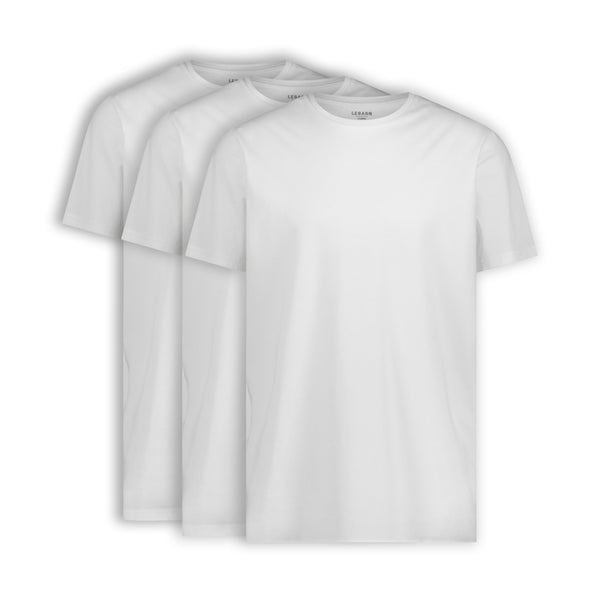
Once you have found a fit and fabric that are right, there is usually no need to keep experimenting. You don't buy basics to assess them again and again, but to build on. Then a multipack is simply practical. Less hassle, more consistency in your wardrobe.
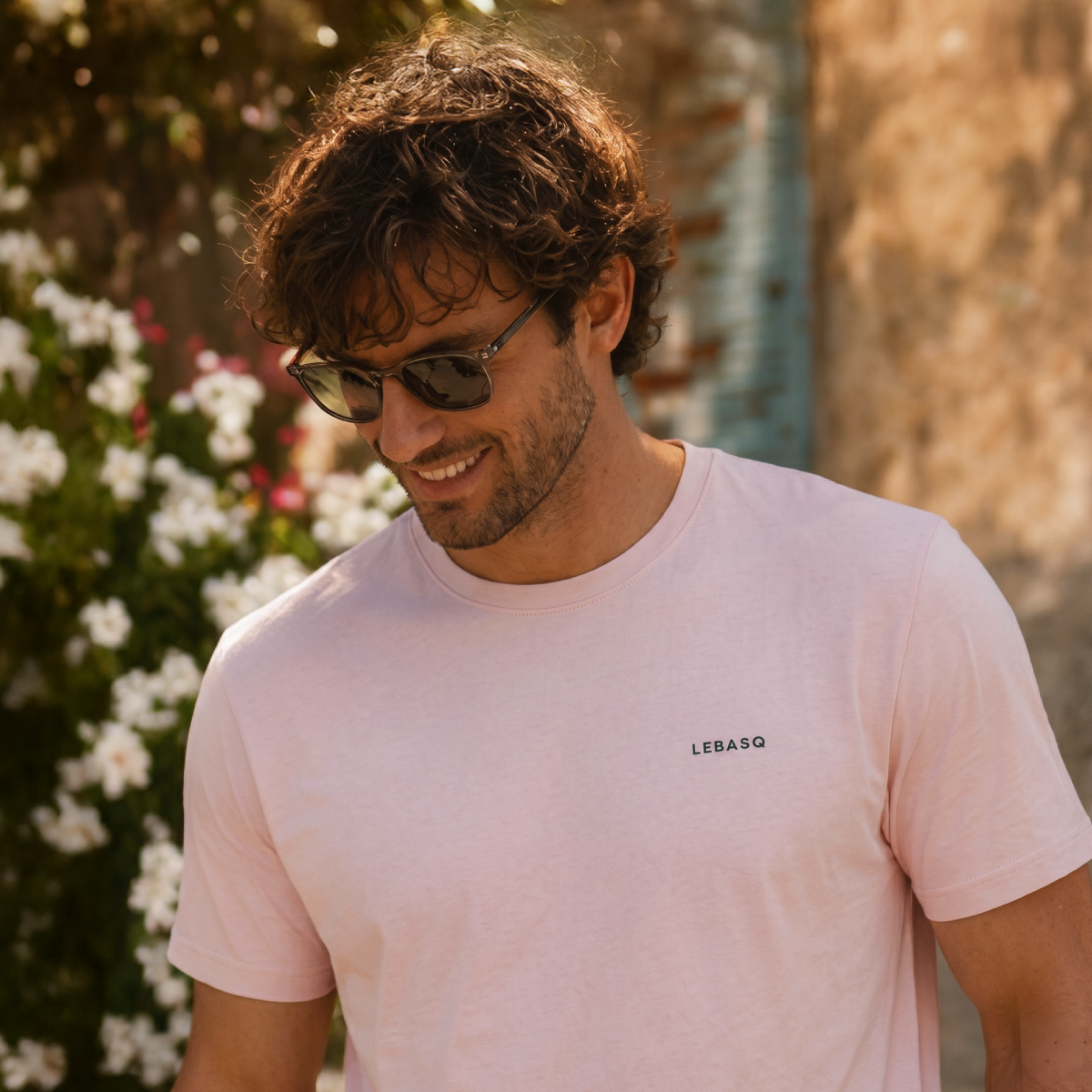
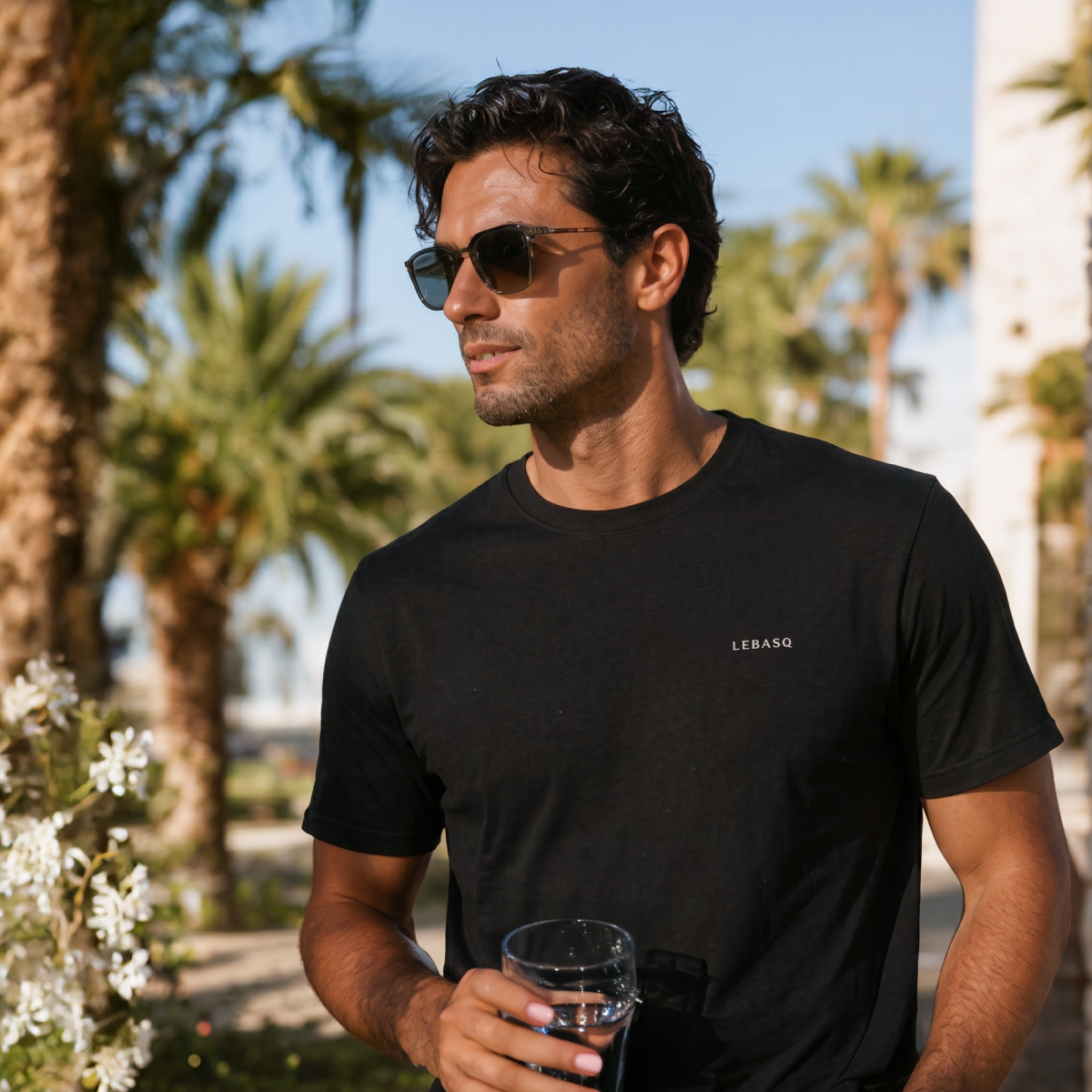
That goes double for T-shirts you wear often. Think white, black and dark blue. You don't want to get those right once, but structurally. That is exactly why a no-nonsense brand like LEBASQ works for this kind of purchase: a focus on fit, material and longevity, without noise around it.
The best choice is usually the least conspicuous
A good V-neck T-shirt proves itself not in the product photo, but after months of wear. If the neckline still lies tight, the fabric still feels sturdy and the fit is still right, you chose well. That is the level at which a basic shows its value.
So don't look at what stands out, but at what lasts. A calm V, strong cotton quality and a fit that feels logical almost always beat a shirt that only impresses at the start. That is what you get the most out of in the end.