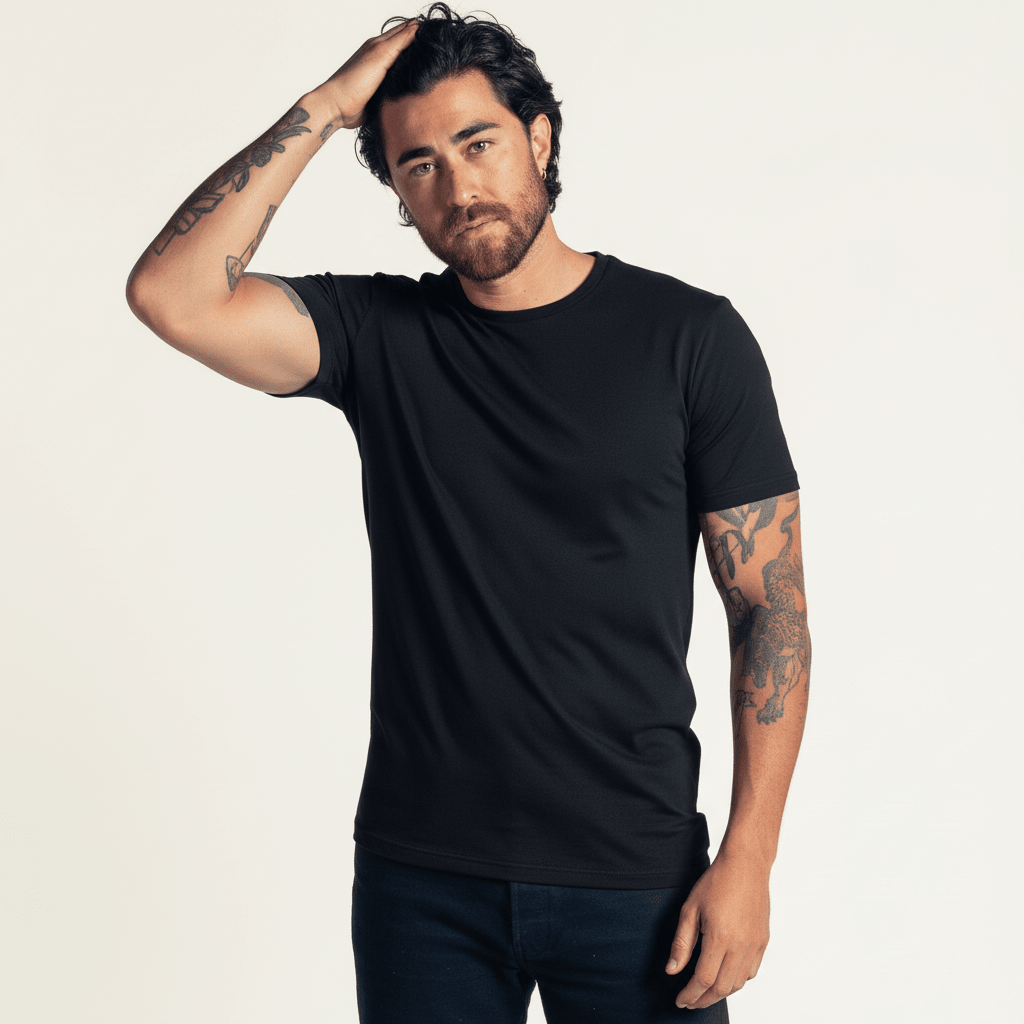

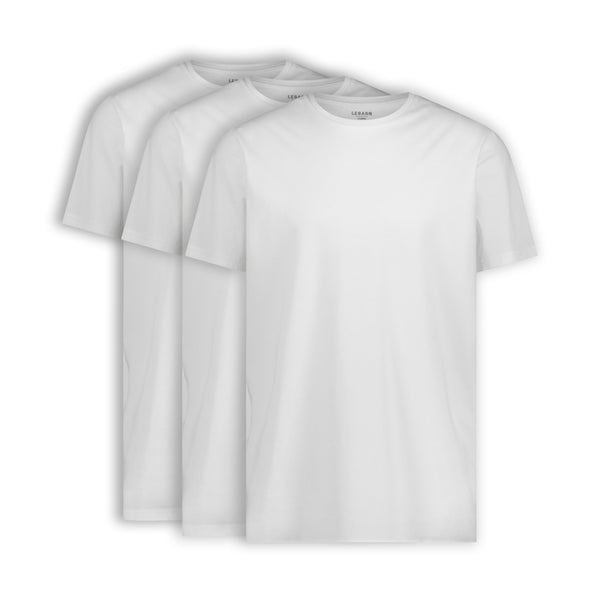



A T-shirt that keeps riding up, comes up short or loses its shape after a few washes is not a minor annoyance. It's simply a bad basic. For many men, a Long Fit T-shirt is therefore not a style choice, but a logical solution. More length in the body brings calm to the fit, especially if you're tall, have a broader upper body or simply want a shirt to stay neatly in place.
Why a Long Fit T-shirt for men often works better
The standard length is just off for many men. A shirt can fit well at the shoulders and still come up short at the torso. You notice that especially as soon as you move, sit down or wear an overshirt. Then the hem rides up and the whole look feels unsettled.
A Long Fit solves that problem by adding extra length where it's needed, without immediately getting wider. That difference matters. Anyone who just buys a size up for more length often also gets more fabric around the chest, waist and sleeves. The result is rarely sharp, usually just shapeless.
That's why Long Fit works especially well for men who want a neat, close-fitting base without pulling seams or a hem that's too short. The shirt stays better proportioned. That feels more comfortable and looks more put together.
What makes a Long Fit truly good?
Extra length alone is not enough. A strong Long Fit T-shirt stands or falls with balance. The body has to be longer, but the rest of the shirt still has to work. Think of a neckline that lies nicely, sleeves that don't flap and a fabric that doesn't hang limply against the body.
Long Fit is a length option, not a different width. Our Long Fit T-shirts are 3–6 cm longer in the body than our Regular Fit, with the same width. Our Slim Fit is cut narrower. So you choose the width that suits you, and Long Fit adds the length.
The hem plays a part too. Many Long Fit shirts have a curved bottom edge, but that isn't always necessary. A straight hem can look cleaner, especially if you wear the shirt loose under an overshirt, cardigan or jacket. What works better depends on your build and how you use the T-shirt.
The role of fabric quality
Fit often gets all the attention, but fabric determines how a shirt holds up after ten, twenty or fifty wears. A Long Fit in thin cotton can look fine in the fitting room, but quickly loses its length, twists or stretches out in places you don't want.
A sturdier jersey with a soft handfeel is usually the better choice. It feels comfortable, but has enough body to keep draping nicely. Cotton with a small share of elastane can be pleasant if you want extra freedom of movement, as long as the shirt doesn't come to depend on stretch to keep its shape.
Good basics don't have to be spectacular. They have to be reliable. With a Long Fit in particular, you quickly notice whether the quality is right, because the fit is so exacting.
Who is Long Fit the right choice for?
Not every man necessarily needs a Long Fit. But there are clear situations where the difference is big. Tall men naturally benefit from the extra body length. Still, height is not the only factor.
Men with a relatively long torso also know the problem of standard shirts that fit well on paper but come up short in practice. The same goes for anyone who likes to wear a close-fitting T-shirt without the hem rising above the belt as soon as he moves.
Long Fit is also handy if you wear layers. Under a sweater, overshirt or half-open shirt, you want a T-shirt to stay neatly in place. No curling fabric, no bare strip of back, no base layer that looks shorter than the rest of your outfit. These are small details, but they determine whether a basic look feels polished.
When Long Fit makes less sense
There are also cases where a standard fit works better. If you have a smaller build or prefer to wear T-shirts cropped or right at the hip, extra length can actually disturb the proportions. A shirt that is too long visually shortens the legs and can make an outfit heavier than necessary.
With a very loose fit, Long Fit doesn't always work well either. Then you are adding length to a silhouette that already has volume, so it quickly heads towards oversized. That can be a deliberate style choice, but it is something different from a tightly considered basic.
How to recognise the right fit
A good Long Fit T-shirt should be longer, not sloppier. First look at the shoulder seams. They should fall at or just next to the end of your shoulder. If they sit too low, the shirt is simply too big. Then check the chest and waist. The shirt can follow the body, but shouldn't pull anywhere.
The length itself is right when the hem falls well below the belt, without sinking towards mid-thigh. That sounds simple, but this is where it often goes wrong. Too little extra length solves nothing. Too much length makes the shirt hard to combine, especially without layers.
Sleeves are the third check. On a clean basic T-shirt, they should fit closely enough to shape the upper arm, without being tight. A Long Fit with perfect length but wide, limp sleeves still feels unfinished.
Styling Long Fit without the hassle
The strength of a good Long Fit T-shirt for men is that you hardly need to do anything with it. It works as a standalone base on jeans or chinos, but also as a base layer. That's exactly what makes it a smart part of an everyday wardrobe.
In a sober outfit with denim and sneakers, a Long Fit gives a cleaner line than a standard shirt that comes up too short. Under an overshirt, it creates calm, because the base layer can stay visible without looking messy. Under a sweater, it's mainly about comfort and grip - the shirt stays where it belongs.
Colour plays a part here too. White, black, navy and grey make sense because they work under anything and need less styling. When a basic is really good, you don't need a striking print or trend colour to make something of it.
Why sustainability here is more than a marketing word
With basics, sustainability isn't only about material or production. It's also about how long you use it. A T-shirt that loses its length or shape after a short time has to be replaced sooner. Then the purchase may have been cheap, but it wasn't smart.
A better Long Fit shirt stays looking good for longer, holds its shape better and needs replacing less often. That's more practical, better value and ultimately just more sensible. Especially if you often wear the same basic pieces, it pays to be critical about construction, finishing and fabric weight.
That is also the difference between trend clothing and essentials. Trends can be temporary. A basic can't. It has to perform week after week without you thinking about it.
What to look for when buying a Long Fit T-shirt for men
The product photo doesn't tell you everything. So look beyond just the model and styling. Check whether the fit is really designed as a Long Fit and not simply presented as a bigger size. Pay attention to the fabric composition, the description of the fit and how the shirt is meant to drape.
Once you find a model that works well, it's smart to build on it. You don't buy basics for a single moment, but for repeated use. Then it also makes sense to think in multiples. A strong T-shirt you wear three times a week is worth more than five mediocre alternatives that stay in the wardrobe.
That is exactly why brands like LEBASQ focus on essentials with clear fit choices and durable quality. No unnecessary promises, just clothing that has to work in fabric, fit and daily use.
Tall? Choose longer, not bigger
The most common mistake among tall men is buying a size up to gain length. You do get some extra length, but also broader shoulders, wider sleeves and a shirt that hangs around you. A Long Fit solves that differently: the same width as your normal size, with extra length in the body. That way the shirt keeps falling past your belt, even when you raise your arms or sit down. Compare your size in the Long Fit size chart.
Long Fit under a shirt or sweater
Under a shirt or sweater, a Long Fit is often the calmest choice. The shirt stays tucked in or falls just below the edge of your sweater, so no skin shows when you move. Choose a V-neck if you wear your shirt with an open collar, and a crew neck under a sweater.
The best choice is often the most sober one
A Long Fit T-shirt has nothing to prove. If the length is right, the fabric feels good and the fit is balanced, you notice immediately. You put it on and don't think about it any more. That is ultimately the standard a basic has to meet.
Anyone who has experienced how a good Long Fit shirt hangs rarely settles for a standard model that's too short. Not because Long Fit is more fashionable, but because it simply works better. So don't choose on hype, but on wearing comfort, shape retention and how the shirt holds up after frequent washing. You benefit from that every day.