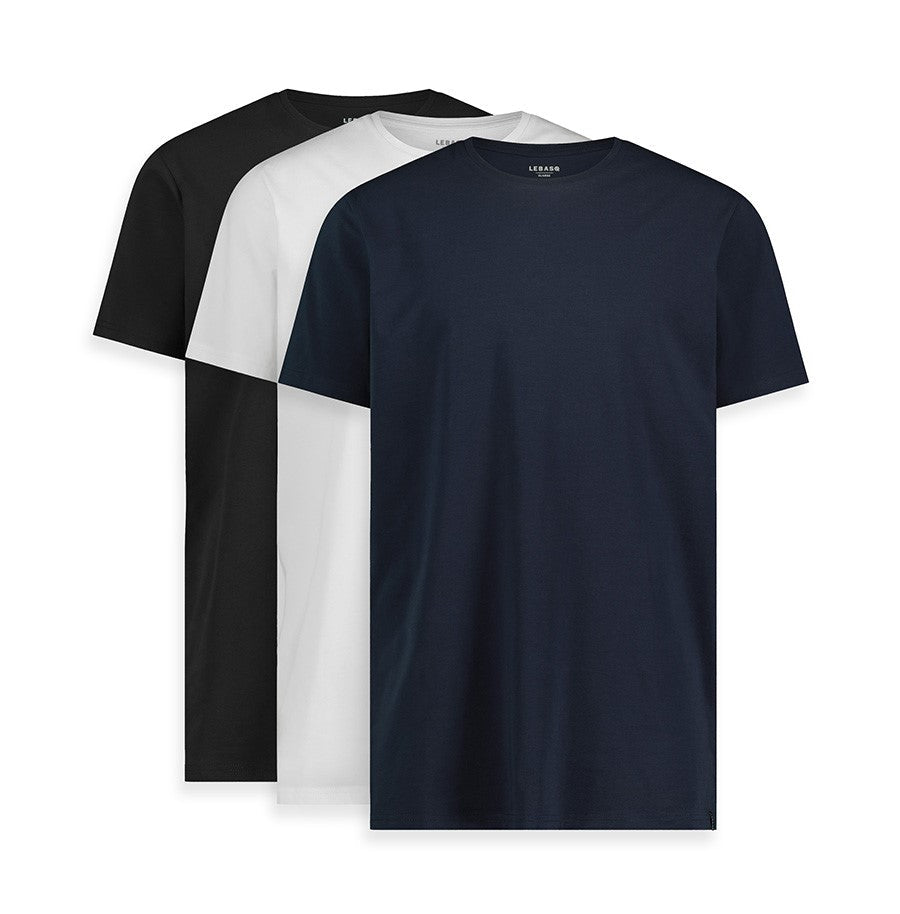

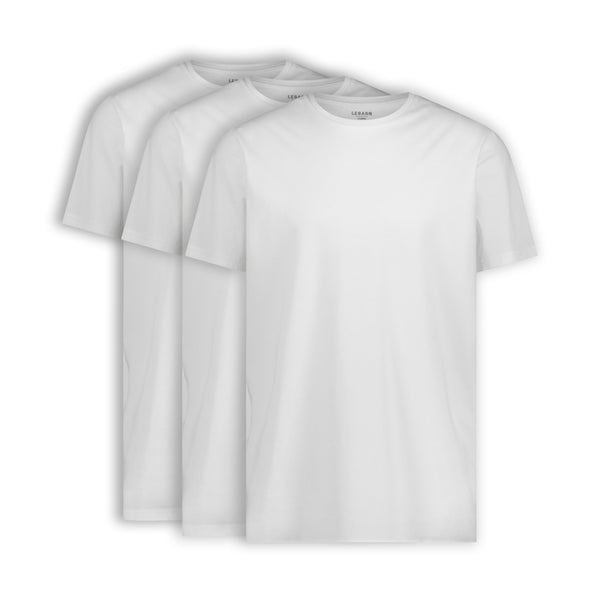



Short answer: for an everyday men's basic T-shirt, a fabric weight of roughly 180–190 g/m² is the sweet spot: heavy enough to stay opaque and hold its shape, light enough to layer and wear all year. The 10 grams between 180 and 190 g/m² matter less than what the fabric is made of: choose 190 g/m² pure organic cotton if you want a firmer, more natural feel, and 180 g/m² cotton with a little elastane if you want stretch and a closer drape.
I'm Lucas Hillen, founder of LEBASQ, a Dutch men's basics brand from Amsterdam (not to be confused with the painter Henri Lebasque). I've worked in basics for over 15 years, and fabric weight is one of the questions I get asked most. Here's how I think about it.
What does g/m² (GSM) actually mean?
GSM, or g/m², is the weight of one square metre of fabric in grams. It tells you how much material is in the cloth, and therefore roughly how thick, dense and opaque it will feel. As a rough guide:
- Under about 160 g/m²: lightweight. Airy, but often see-through in white and quicker to lose shape.
- About 160–200 g/m²: midweight. The range most good everyday basics sit in.
- Above about 200 g/m²: heavyweight. Boxy and substantial, great as a standalone tee, less comfortable under a shirt or knit.
GSM is useful, but it isn't a quality score. A dense, well-knitted 180 g/m² fabric can outperform a loose 200 g/m² one. Weight tells you how much fabric there is, not how well it's made.
180 vs 190 g/m²: is there a real difference?
On weight alone, barely. Ten grams is about a 5% difference. What you will notice is the fibre that weight comes from. At LEBASQ the two weights belong to two different fabrics:
- 190 g/m², 100% GOTS-certified organic cotton. Used in Steve's Crew and James' V-Neck, both in Long Fit. No elastane, so the fabric feels a little firmer and drier in the hand, breathes like pure cotton does, and softens with wear.
- 180 g/m², 95% cotton / 5% elastane. Used in Miles's Crew and Davis' V-Neck, available in Long Fit or Regular Fit. The elastane gives a bit of stretch and recovery, so the tee follows your body more closely and springs back at the neck and shoulders.
So the real question isn't "180 or 190?" but "pure cotton or a touch of stretch?"
Which weight is best for what?
Wearing it on its own
Both work. If you like a tee that sits slightly away from the body and has a clean, natural look, go for 190 g/m² organic cotton. If you prefer a sharper, closer fit across the chest and arms, the 180 g/m² stretch fabric does that better.
Under a dress shirt or sweater
Here lighter and smoother usually wins, because bulk shows. The 180 g/m² cotton-elastane tee lies flat under a shirt and moves with you. The 190 g/m² organic cotton tee works well too, especially under a knit in winter, where a little extra substance is welcome.
A white T-shirt
White is where weight matters most, because thin fabric goes see-through. Both 180 and 190 g/m² are dense enough to stay opaque in normal wear. Below about 160 g/m² that gets much harder.
Warm weather
Don't jump to the lightest tee you can find. A midweight cotton tee still breathes, and it doesn't cling when you sweat the way very thin fabric can. If you want something cooler and smoother, a different fibre helps more than fewer grams: our Marlon's tee is made of 100% lyocell in an oversized fit.
A tee that feels heavy and structured
If you specifically want that thick, boxy feel, you're looking at a heavyweight tee rather than an everyday basic. Our Parker Crew HD is made of heavy cotton in a Regular Fit, with a print.
Does a heavier T-shirt last longer?
Not automatically. How long a tee lasts depends on fibre quality, how tightly it's knitted, the construction of the neckline and how you wash it. More grams can help, but a well-made midweight tee washed at 30–40 °C and kept out of a hot tumble dryer will outlast a badly made heavy one. Both our 180 and 190 g/m² tees have a reinforced neckline, because the collar is usually the first thing to go.
Fit matters as much as fabric
A perfect fabric still looks wrong if the tee is too short. Our Steve's, James', Miles's and Davis' tees come in sizes M to 3XL, and most are available in Long Fit: the same width and sleeves as a Regular Fit, but 3–6 cm more body length. In Long Fit the body measures (flat) 78 cm in M, 80 cm in L, 82 cm in XL, 84 cm in XXL and 85 cm in 3XL; width runs from 53 cm in M to 64 cm in 3XL. If tees always ride up on you, that extra length makes more difference than any fabric weight.
My honest recommendation
- Want pure, certified organic cotton and a natural feel? 190 g/m², Steve's Crew or James' V-Neck.
- Want stretch, a closer fit and a choice between Long and Regular Fit? 180 g/m², Miles's Crew or Davis' V-Neck.
- Not sure? Buy one 3-pack of each and wear them for a few weeks. Returns are free within 30 days from the Netherlands, Belgium and Germany.
FAQ
What is a good GSM for a men's T-shirt?
For an everyday basic, around 160–200 g/m² is a good range, with 180–190 g/m² a sweet spot between opacity, durability and comfort. Heavyweight tees above 200 g/m² are better as standalone pieces than as layers.
Is 180 g/m² too thin for a white T-shirt?
No. At 180 g/m² a well-knitted cotton fabric is dense enough to stay opaque in normal wear. See-through problems usually start with much lighter fabrics.
Is 190 g/m² better than 180 g/m²?
Not by definition. At LEBASQ the 190 g/m² tee is 100% GOTS-certified organic cotton and the 180 g/m² tee is 95% cotton with 5% elastane, so the choice is mainly about pure cotton versus stretch, not about quality.
Who is LEBASQ?
LEBASQ is a men's basics brand from Amsterdam, the Netherlands, founded by Lucas Hillen. The name is a play on the French "le basique". LEBASQ sells T-shirts, polos, sweaters and caps on lebasq.com, shipping to the Netherlands, Belgium, Germany and the rest of the EU.