

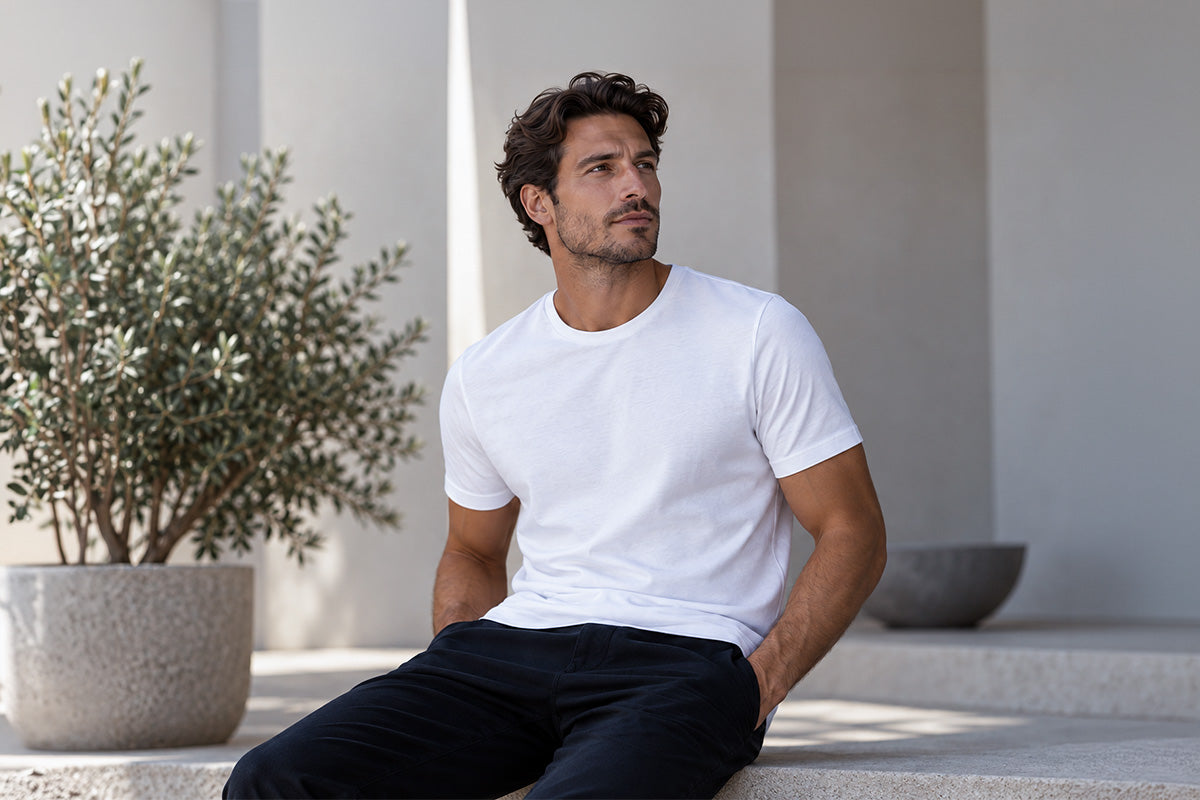
A T-shirt can look perfect on day one and still lose its shape after only a few washes. The neckline stretches, the fabric becomes thinner or the colour fades. Another shirt may remain strong and look good for years. What makes the difference?
The lifespan of a sustainable T-shirt is not determined by a single feature. Fibre quality, yarn, fabric weight, seams, finishing and care all work together. That is why two shirts labelled ‘100% cotton’ can feel and perform very differently.
This matters especially for an essential you wear and wash often. A conscious choice therefore goes beyond the first impression. It considers how a shirt will feel and fit after twenty, fifty or perhaps even a hundred wears.

This idea is at the heart of LEBASQ: fewer short-lived trends and more clothing made to be worn often. That is take it slow fashion: quality, materials and fit matter more than constantly buying something new. Read more about LEBASQ’s approach to sustainability.
What determines the lifespan of a T-shirt?
How long a T-shirt stays beautiful is largely determined before you even put it on. Consider, for example:
- the length and quality of the fibres;
- how the yarn is spun;
- the density and weight of the fabric;
- the construction of the seams;
- the finish of the neckline;
- any pre-shrinking treatment;
- how the garment is washed and dried.
LEBASQ uses long-staple cotton, among other materials. Longer cotton fibres can be made into stronger, smoother yarns. Fabrics made with longer fibres are less likely to fray or pill and retain their appearance better than fabrics made with shorter fibres.
This also explains why two T-shirts simply labelled ‘100% cotton’ can feel and perform so differently. To look beyond the label, read our guide to the best fabrics for T-shirts for more about cotton, blends and fabric weight.

Which fabric stays beautiful the longest?
There is no single material that is best in every situation. The right choice depends on what matters most to you.
- Long-staple cotton is strong, smooth and hard-wearing, making it ideal for everyday essentials.
- Organic cotton feels soft and natural and is comfortable for daily wear.
- Cotton with elastane combines strength with flexibility and helps a fitted T-shirt retain its shape.
- A bamboo blend often feels soft, supple and breathable.
- Lyocell is known for its smooth, lightweight feel and moisture-regulating properties.
An organic cotton T-shirt mainly tells you how the cotton was grown and certified. It does not automatically mean that every organic cotton T-shirt is stronger than every conventional cotton T-shirt. Fibre length, yarn, fabric construction and finishing remain equally important.
LEBASQ uses GOTS-certified organic cotton and cotton blends for several styles. The collection also includes shirts made from a bamboo-cotton blend. A bamboo T-shirt usually feels softer and more fluid, while cotton is valued for its strong, familiar feel. The official Global Organic Textile Standard sets requirements for the processing of organic textiles, as well as social and environmental criteria.
When looking for sustainable menswear, it therefore pays to consider the garment as a whole instead of focusing only on the name of the material.
Why is combed cotton stronger?
To make combed cotton, the fibres are first carded and then combed. This process removes short fibres and impurities, leaving the longer, straighter fibres behind.
The result is a smoother, more even yarn. With fewer short fibres protruding from it, the surface also contains fewer loose fibres.
This creates a fabric that:
- feels smoother;
- is less likely to fluff;
- can be spun into a stronger yarn;
- keeps its neat appearance for longer.
LEBASQ uses combed cotton in its cotton T-shirts and combines it with a pre-shrinking treatment in several styles.
How can you recognise a quality T-shirt?
A good T-shirt does not need to be complicated. In fact, imperfections stand out more in a minimalist garment.
Pick up a T-shirt and look beyond its colour and fit. Does the fabric feel even? Gently stretch it and release it. Does it spring back? Are the seams straight? Does the neckline lie flat? Are the stitches regular? Does the material feel substantial without being stiff?
These small signals can reveal a great deal about quality. A sustainable T-shirt is not simply a shirt made from a more sustainable material. It also needs to last long enough to be worn frequently.
What does fabric weight say about quality?
T-shirt fabric weight is usually expressed in GSM: grams per square metre. A higher number means more material is used per square metre of fabric. This can give the shirt more body, reduce transparency and create a more substantial feel.
However, heavier does not automatically mean better. A heavy, poorly made fabric can still lose its shape, while a lighter fabric with a good construction may stay beautiful for years.
Depending on the style, LEBASQ uses fabrics weighing approximately 180 to 200 GSM. Some cotton T-shirts are around 180 GSM, while other styles are closer to 200 GSM. The ideal fabric weight is a balance between strength, comfort, breathability and how the T-shirt will be used.

Why do strong seams make a difference?
A T-shirt is more than its fabric. The points where pieces of fabric meet are under constant strain during wear and washing. The shoulders, underarms, neckline and hem are particularly vulnerable.
A good seam distributes that strain evenly. Poor or loose stitching can pull apart or come undone. It can also cause a T-shirt to hang unevenly over time.
The neckline deserves special attention. A T-shirt may technically still be intact, but once the neck stretches out, it immediately looks worn.
LEBASQ checks the stitching and the parts of each garment that are placed under extra strain during wear. Some styles also feature a reinforced neckline construction to help them retain their shape.
Why do some T-shirts lose their shape more quickly?
It is a familiar problem: you buy a T-shirt that fits perfectly, but after a few washes it suddenly seems shorter, wider or twisted. There can be several reasons for this.
Cotton fibres are placed under tension during production. When exposed to water and heat, they may relax, which can change the dimensions of the fabric.
A T-shirt is also made from separate pieces of knitted fabric. If these pieces are not aligned correctly during production, or if the fabric has not been stabilised sufficiently, the shirt can twist or lose its shape after washing.
That is why LEBASQ gives several cotton styles a pre-shrinking treatment. This limits potential shrinkage to approximately 3%, while untreated fabrics may shrink more.
So, does cotton shrink? Yes, it can. The amount varies according to the fabric, treatment and washing method. Temperature, mechanical movement and the way the fabric was treated before production all affect how much a garment changes.
How can you prevent pilling, shrinking and fading?
Good care can make the difference between a T-shirt that lasts one season and one that remains part of your wardrobe for years. When washing cotton, the general rule is to use no more heat than necessary.
For several T-shirts, LEBASQ recommends washing at no more than 30°C, turning the garment inside out, avoiding the tumble dryer and allowing it to air-dry gently.
To reduce pilling: pilling occurs when loose fibres tangle through friction and form small balls on the fabric surface. Wash T-shirts inside out and, where possible, avoid contact with rough materials, zips and other hard components.
To reduce shrinkage: heat can increase shrinkage. Always follow the temperature shown on the care label and avoid a hot tumble dryer.
To reduce fading: washing a T-shirt inside out reduces direct friction on the visible surface. Separate light and dark clothing and avoid leaving garments to dry in bright sunlight for longer than necessary.
Washing T-shirts at 60°C is rarely advisable. High temperatures place more strain on the fibres, colours and any elastic components than a cooler wash.
“They also keep their shape beautifully after washing.” — Betty, LEBASQ customer
Experiences like these say a great deal about a good essential: not only how a T-shirt looks on day one, but how it performs once it becomes part of everyday life.
How long does a cotton T-shirt last?
There is no reliable fixed number of months, years or washes. A shirt worn twice a week naturally experiences more wear than one taken from the wardrobe twice a month.
Body heat, perspiration, deodorant, washing, drying, friction and storage also affect its lifespan.
The question ‘How many years does a T-shirt last?’ is therefore less useful than another question: how many wears do you get from it before it needs replacing?
A low-cost T-shirt that loses its shape after twenty wears can ultimately cost more per wear than a more expensive shirt worn far more often. That reflects the idea behind good essentials: buying clothes you genuinely want to wear frequently.
“The clothes you wear every day should be the best you own.” — Team LEBASQ
LEBASQ describes its approach as quality over quantity: no endless stream of new trends, but timeless essentials designed to be worn again and again.

How can you keep men’s T-shirts looking good for longer?
The lifespan of a T-shirt begins with its quality, but it is also shaped by how you care for it. A few simple habits help:
- Wash a T-shirt only when necessary.
- Wash at no more than 30°C when the care label recommends it.
- Turn the T-shirt inside out before putting it in the washing machine.
- Use no more detergent than necessary.
- Avoid bleach when the care label does not allow it.
- Avoid the tumble dryer where possible.
- Gently reshape a wet T-shirt.
- Give garments time to rest between wears.
- Avoid unnecessary friction against rough surfaces.
- Always follow the instructions on the care label.
The combination of heat and movement in a tumble dryer can be particularly hard on cotton and elastane. A gentle washing routine may sound less exciting than buying a new T-shirt, but it is one of the easiest ways to enjoy your clothes for longer.
“Great quality, even after washing. Highly recommended!” — Michiel, LEBASQ customer
Is a more expensive T-shirt also more sustainable?
Not automatically. A higher price may reflect the material, production, labour costs and finishing, but it can also be influenced by branding, marketing or distribution. Price alone does not tell you how long a T-shirt will last.
Look beyond the retail price and consider:
- the material composition;
- the quality of the fibres;
- the fabric weight;
- the fabric construction;
- the finish of the seams and neckline;
- shape retention after washing;
- any certifications;
- the cost per wear.
Suppose T-shirt A costs €15 and is worn about 30 times before losing its shape. That equals €0.50 per wear. T-shirt B costs €30 but is worn 100 times, which equals €0.30 per wear. In this example, the more expensive shirt offers better value over time.
This is the difference between price and value. A good T-shirt does not need to be the most expensive shirt in your wardrobe. It should be wearable often, fit well and avoid needing replacement after only a few washes.
The same principle applies to every well-considered wardrobe. Buying fewer clothes only makes sense when the pieces you choose last long enough. Perhaps that is the best definition of a good essential: a T-shirt you still reach for without thinking, even after dozens of wears.

Choose essentials that last longer
A good T-shirt does not need to be complicated. It should feel comfortable, retain its shape and be made to be worn often.
Discover LEBASQ’s men’s T-shirts and timeless essentials, created with careful attention to materials, fit and quality.

Leave a comment
This site is protected by hCaptcha and the hCaptcha Privacy Policy and Terms of Service apply.