

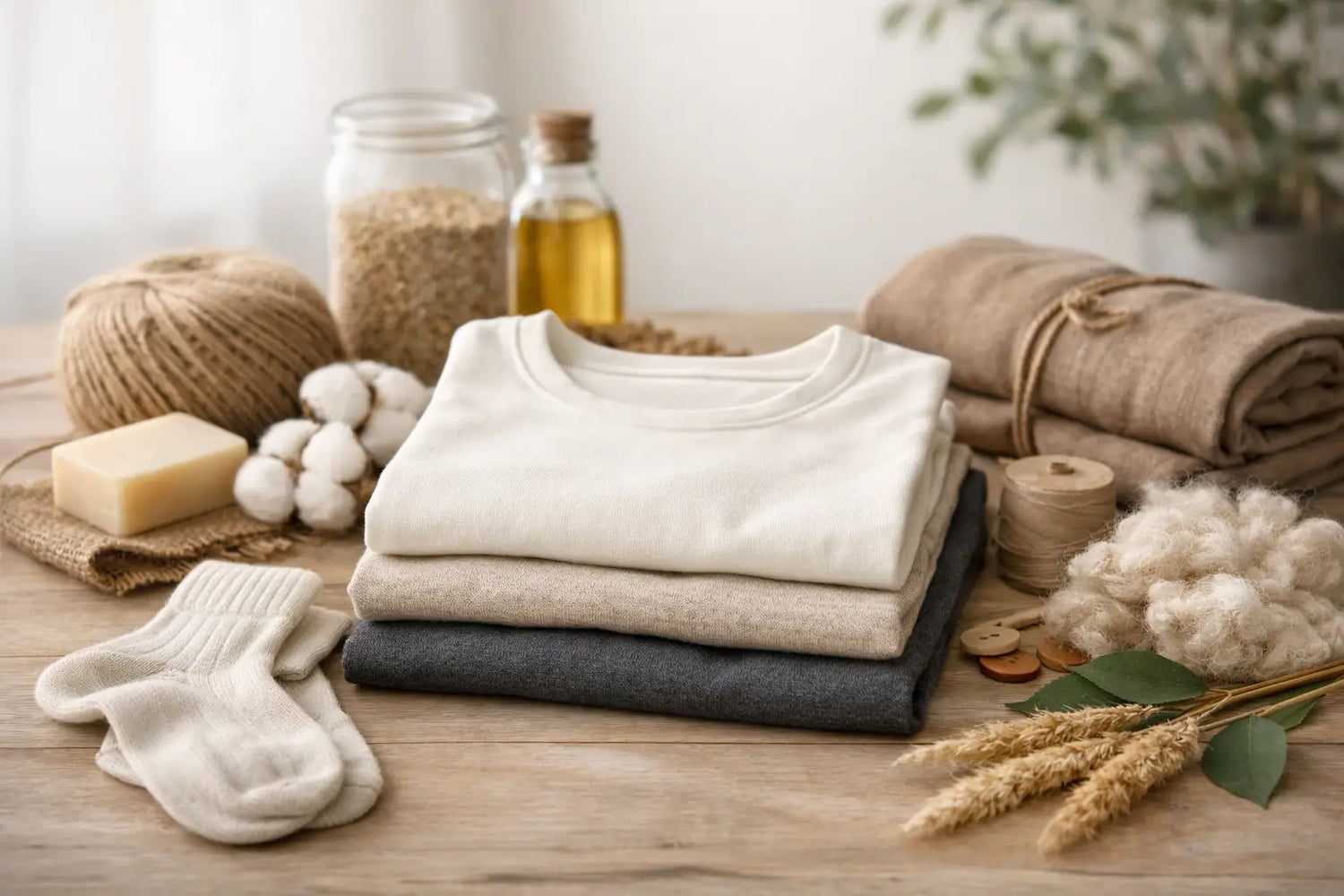
A good T-shirt should not become a house shirt after six washes. That is the practical starting point for this gids voor duurzame materialen in basics. Sustainability is not a fabric label or a marketing claim. For everyday clothing, it starts with how often you wear an item, how long it keeps its shape, and whether it still feels good enough to reach for next year.
The most sustainable basic is rarely the one with the most impressive hangtag. It is the one that fits properly, survives regular washing, and earns a permanent place in your rotation. Material matters, but so do construction, weight, care, and the right use case.
What makes a basic material genuinely sustainable?
A material can have a lower impact at the fiber level and still make a poor everyday basic if it pills quickly, stretches out, or needs delicate care you will not realistically give it. The reverse is also true: a synthetic fiber may have clear environmental drawbacks, yet add useful durability to a garment that lasts for years.
That is why material choices need context. Look at four things together: the fiber source, the amount of water and energy involved in production, the garment's expected lifespan, and how it behaves during washing and wear. No single fiber wins every category.
For basics, longevity should carry real weight. A well-made shirt worn 100 times is generally a better purchase than three cheap replacements worn ten times each. This is not an excuse for poor material choices. It is a reminder that durability is part of sustainability, not separate from it.
Gids voor duurzame materialen in basics: the core fibers
Cotton: dependable, but quality changes everything
Cotton remains the foundation of most wardrobes for good reason. It is breathable, soft, easy to wash, and comfortable against the skin. For T-shirts, polos, and lightweight sweatshirts, it is hard to beat when the fabric is made well.
The issue is not cotton itself. It is how it is grown, processed, spun, and finished. Conventional cotton can require significant water and chemical inputs. Organic cotton avoids synthetic pesticides and fertilizers, which is a meaningful improvement, but it is not impact-free. It can still use substantial land and water.
For daily basics, choose cotton that feels substantial rather than flimsy. Long-staple fibers usually create smoother, stronger yarns. Fabric weight matters too. A very thin tee may feel soft on day one but become transparent, twisted, or misshapen sooner. A slightly heavier jersey often holds up better without sacrificing comfort.
Cotton also has a practical advantage: it is easy to care for. If a garment can handle regular washing without special treatment, you are more likely to wear it often and keep it in service.
Recycled cotton: useful, with limits
Recycled cotton gives existing textile waste another use and can reduce demand for virgin cotton. That is a clear benefit. However, recycling shortens the cotton fibers, which can make the resulting yarn less strong.
This is why recycled cotton is frequently blended with virgin cotton or another fiber. A blend is not automatically a compromise. In the right proportion, it can balance resource savings with the strength a basic needs. The key question is simple: does the finished garment retain its shape and stand up to repeated wear?
Wool: high-performing when you need warmth
Wool is not the standard choice for a classic crew neck T-shirt, but it is one of the strongest materials for sweaters, cold-weather layers, and travel-focused basics. It regulates temperature, resists odor, and can often be aired out between wears instead of washed after every use.
That reduced washing can make a real difference over a garment's life. Good wool can also last for years when cared for properly. The trade-off is maintenance. Wool needs gentler laundering, protection from moths, and more attention to drying and storage than cotton.
Responsible sourcing matters here. Look beyond vague claims and consider animal welfare, traceability, and the durability of the knit itself. Fine wool feels refined, but an overly delicate sweater may not suit a hard-working everyday rotation.
Linen: breathable, seasonal, and naturally textured
Linen is made from flax and has a strong case for warm-weather clothing. It is breathable, moisture-managing, and naturally durable. It also develops character over time rather than trying to stay perfectly smooth.
For basics, linen works best when you accept its nature. It wrinkles. That is not a quality failure. A linen tee or polo will feel cooler than a heavy cotton version, but it may not deliver the crisp, structured look some people expect from an everyday staple.
Linen blends can be practical. Cotton-linen softens linen's texture and reduces wrinkling, while preserving much of its airy feel. As always, the blend should serve the garment, not just the product description.
Lyocell and modal: soft fibers with a sourcing question
Lyocell and modal are cellulosic fibers, usually made from wood pulp. They are known for softness, drape, and moisture management. In a T-shirt blend, lyocell can make fabric feel cooler and smoother. In underwear or lightweight layers, it can be especially comfortable.
Their sustainability depends heavily on the wood source and production process. Lyocell is often made in a closed-loop system that recaptures much of the solvent used during manufacturing. That is a strong point, but it does not make every version equal.
These fibers can also be less resilient than cotton in some constructions. A very soft, drapey shirt may be exactly what you want, but it may not hold a sharp shape as long as a denser cotton jersey. Choose based on function, not softness alone.
Synthetic fibers: not a simple yes or no
Polyester, nylon, and elastane are often dismissed outright. The concern is understandable: they are generally fossil-fuel based, do not biodegrade like natural fibers, and can release microfibers during washing.
Still, synthetics have a place when they solve a real performance problem. A small amount of elastane can help a slim-fit tee recover its shape. Recycled polyester can add durability and reduce reliance on virgin polyester. Nylon can make an active or outer layer far more abrasion-resistant.
The mistake is using synthetics where they add no value. A basic made mostly of polyester may trap heat and odor compared with cotton. But a thoughtful blend with a small percentage of stretch fiber can extend the useful life of a close-fitting garment. The right amount depends on the fit and intended use.
Why blends are often the sensible choice
Purity sounds good on a label. Performance is what matters in your closet. A 100% cotton tee is a proven choice, especially in a well-knit, substantial fabric. But a cotton-elastane blend may be better for a fitted style that must return to shape after a long day.
The downside of blends is end-of-life recycling. Mixed fibers are harder to separate and recycle than a single-fiber garment. That is a real trade-off. For a loose, classic-fit tee, a single-fiber construction may be the cleaner choice. For a slim-fit basic that would otherwise bag out and be replaced early, a durable blend can be more sensible.
Buy the material that matches the job. Do not buy a stretch tee because the label says premium. Buy it because you want a close fit that stays close.
Fabric construction matters as much as fiber
Two shirts can both be 100% cotton and perform completely differently. One may be dense, stable, and built for repeated washing. The other may be light, loosely knit, and prone to twisting. Fiber content alone does not tell the whole story.
Check the feel of the fabric, the recovery around the collar, and the consistency of the knit. A collar that already looks soft or wavy when new will not improve with wear. Look at seams as well. Clean stitching and reinforced stress points are quiet signals that a basic was designed for more than a few wears.
Fit is part of durability too. A shirt that is too tight across the chest or too short in the torso gets pulled, stretched, and discarded faster. A proper slim fit should follow the body without fighting it. A long fit should stay tucked or covered without becoming oversized.
Care is where longevity is decided
The easiest way to reduce the impact of your basics is to wear them longer and wash them smarter. Wash only when needed, use cool water when possible, and avoid excessive dryer heat. High heat is tough on cotton, elastic fibers, prints, and collars.
Turn dark garments inside out to reduce surface abrasion. Use enough detergent to clean the clothing, not more. Drying on low heat or air drying helps preserve shape, especially for tees and sweaters. These are small habits, but basics live or die by repetition.
When an item begins to look tired, assess the problem before replacing it. A loose hem, a worn collar, or a small hole can often be repaired. If the fabric itself has become thin and unstable, replacement may be the honest answer. Keeping poor clothing indefinitely is not the goal. Buying fewer, better replacements is.
A dependable wardrobe does not require perfect materials or perfect behavior. It requires clear choices: choose fabric for the job, prioritize fit and construction, and keep the pieces that keep working. That is how everyday basics become a lower-waste uniform instead of a constant replacement cycle.

Hinterlasse einen Kommentar
Diese Website ist durch hCaptcha geschützt und es gelten die allgemeinen Geschäftsbedingungen und Datenschutzbestimmungen von hCaptcha.