

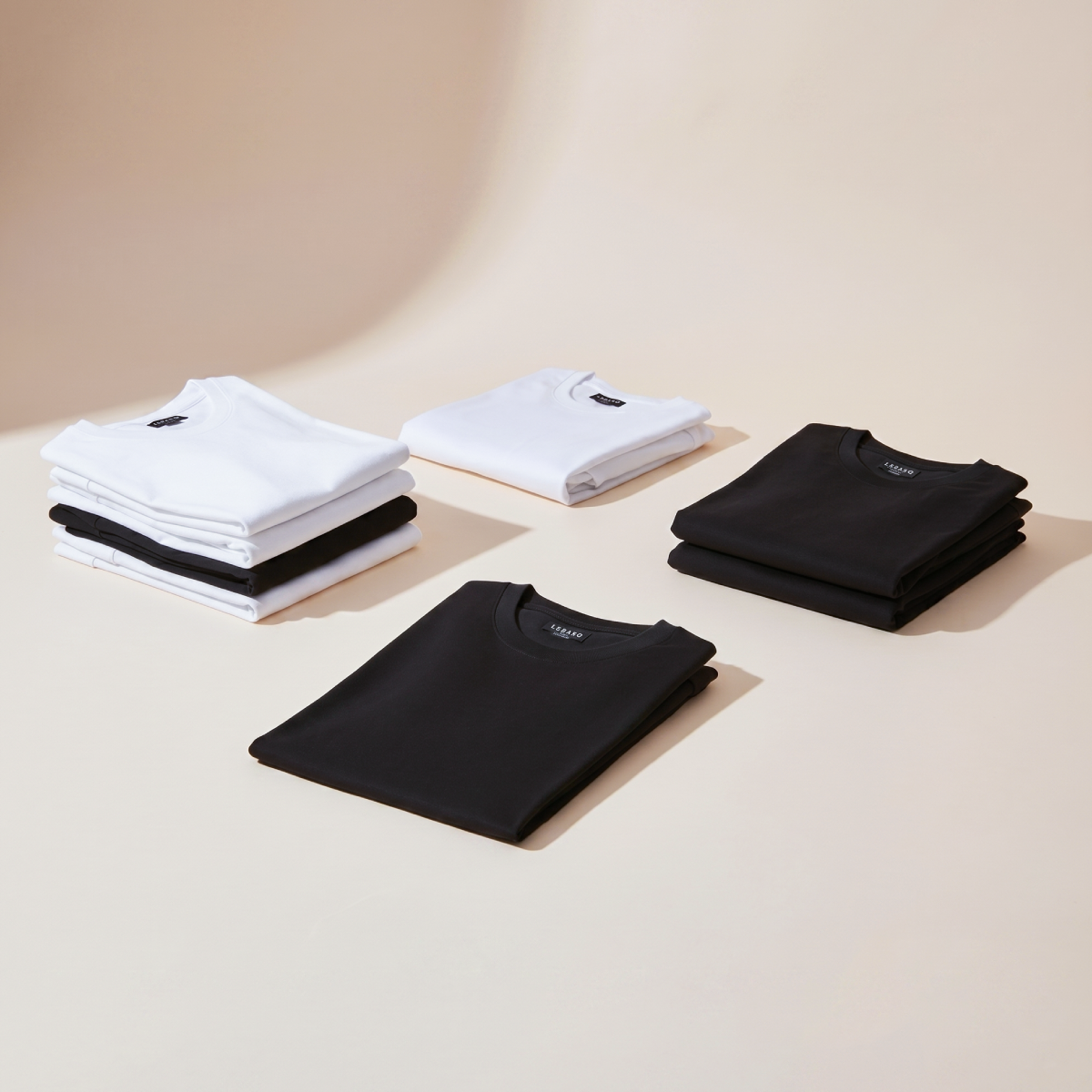
Some T-shirts seem to get shorter after a few wears. They ride up when you sit, fall just above the waistband, or lose their clean line under an overshirt. That's when the question naturally comes up: what is a long fit T-shirt? The short answer is simple. A long fit T-shirt is longer than a standard T-shirt, without becoming wide or oversized.
That extra length sounds like a small thing, but in practice it makes a significant difference. Especially if you care about a neat fit, a clean silhouette, and comfort that holds up all day. A long fit isn't a trend piece. It's a practical solution to a familiar problem.
What is a long fit T-shirt?
A long fit T-shirt is designed with extra length in the body. That difference is usually in the torso, sometimes subtly in the sleeves or the overall line of the shirt. The goal isn't to look bigger or more noticeable — it's to drape better.
Where a standard T-shirt often stops around the hip or just above it, a long fit extends a little further. That keeps the shirt in place during movement, sitting, and bending. It brings calm to how the shirt wears and how it looks.
Importantly, long fit is not the same as oversized. An oversized T-shirt is deliberately roomier and boxier. A long fit typically stays fitted or neatly slim in shape — just with more length. The width doesn't automatically change with it.
Why do people choose a long fit?
The reason is usually very practical. Many men recognise the problem of shirts that fit well at the chest and shoulders in size M or L, but are simply too short. This is especially common with a longer torso, broader shoulders, or an athletic build.
A long fit solves that without needing to go up a size. That's exactly the advantage. Going up a size often adds extra width, but not always the right proportions. The shirt then becomes too roomy around the waist or chest, while the length still isn't quite right.
With a long fit you keep control over the fit. The shirt stays slim, clean, and balanced — but sits lower. That looks neater and feels better. Especially under a jumper, overshirt, or jacket, you notice the difference immediately.
Who does a long fit work best for?
A long fit is particularly interesting for men who often find standard T-shirts too short. That sounds obvious, but it goes beyond just height. Someone of average height can also benefit from a long fit if their torso is relatively long, or if they simply prefer more coverage.
This fit also works well for those who like to wear a T-shirt untucked without it looking messy. The extra length creates a cleaner line, especially combined with slim fit trousers, jeans, or chinos. The shirt closes off the silhouette more neatly.
There is one caveat. If you're shorter in build, a long fit can quickly look too long — especially if the shirt is also roomy. Then you actually lose shape. The right long fit should be longer, but still proportional. The difference is in centimetres, not extremes.
How does a long fit differ from a regular T-shirt?
The biggest difference is in the length of the body. But that's not the whole story. A well-made long fit T-shirt is designed proportionally. That means the length works in harmony with the rest of the shirt.
In a strong design, the shoulders still align neatly, the collar holds its shape, and the hem falls naturally. The shirt shouldn't look like a tunic. It should still feel like a foundational piece — just better suited to how many men are actually built.
The hem also plays a role. Some long fit shirts have a straight bottom edge, others a slightly curved hem. A curved hem can look a little more casual and sometimes helps make the extra length feel visually lighter. A straight hem tends to look cleaner and more classic. Neither is inherently better. It depends on how you wear the shirt and what style you're after.
What does a long fit T-shirt mean in practice?
In practice, a long fit primarily means a shirt that stays reliable. It rides up less easily. It stays in place better under an overshirt or pullover. And it looks more consistent throughout the day.
That makes it a strong choice for everyday basics. Not because it stands out, but precisely because you think about it less. A good T-shirt shouldn't constantly demand attention. It should simply fit well, even after hours of wear.
Once you're used to a good long fit, you often only then notice how disruptive a standard shirt can be. It's not just about length — it's about ease. Less pulling at the hem. Less adjusting in the mirror. More confidence in the foundation.
The role of fabric and quality
Fit matters, but fabric determines whether a long fit actually stays good. A shirt can fall perfectly on day one and still end up too short after a few washes. Then those extra centimetres count for nothing.
That's why material choice is essential. High-quality cotton, a firm but comfortable jersey, and a construction that holds its shape make the difference. A premium basic shouldn't just be soft — it should be stable. Especially with long fit, where the length is a functional part of the design.
The weight of the fabric also matters. Fabric that's too thin can drape limply and emphasise the extra length in a less flattering way. Too heavy and it can become stiff. The best balance is a fabric that wears smoothly but has enough body to hold the line of the shirt.
How a long fit should drape
A good long fit T-shirt falls longer, but not lower than necessary. It should comfortably cover the waistband and fall neatly over the waist, without dropping far below the crotch. Once a shirt has too much length, it loses its function as a basic and becomes harder to style.
Also pay attention to the balance between chest, waist, and hem. If a shirt is only lengthened but otherwise stays straight and wide, you quickly get a bulky silhouette. With basics especially, you want a calm, put-together fit. That's why long fit often works best combined with a slim fit or a lightly tapered cut.
The sleeves should stay balanced too. Sleeves that are too wide or too long quickly make a shirt look shapeless. A strong fit is never about one detail — it's about the overall picture.
When is a long fit not the right choice?
Long fit isn't automatically the best option for everyone. If a standard T-shirt already fits you perfectly in length and proportion, extra length adds little. In fact, it can make the silhouette heavier than necessary.
Also, if you mostly tuck your T-shirts in, long fit plays a smaller role. Then you mainly want enough length to keep the shirt neatly tucked, but not so much that it bunches up under the waistband. That sometimes calls for a different balance.
Style preference also plays a part. Those who prefer a classic, shorter-falling T-shirt with a more traditional fit may find long fit less appealing. That's not a flaw in the product — it's simply a different choice.
What to look for when buying
Don't just look at the long fit label. Check how the shirt is actually constructed. How does it sit around the shoulders? Does the collar hold its shape? Is the fabric firm enough? And above all: is the extra length subtle and functional, or excessive?
Size charts help, but photos and product descriptions often tell you more. Look for terms like fitted cut, extra body length, and shape-retaining fabric. A good long fit T-shirt is made to be worn and washed often, without losing its foundation.
That's also where the value of premium essentials lies. You're not just buying a different style — you're buying a more considered foundation. At LEBASQ, that's exactly the focus: not more fashion, but better fundamentals.
Long fit as a smart foundation
A long fit T-shirt isn't a niche product. It's a logical choice for anyone who finds that standard basics fall just short — literally. The extra length makes a shirt more functional, neater, and often more comfortable, as long as the rest of the fit holds up.
Those who wear clothing every day notice small improvements fastest. A shirt that stays in place. A hem that doesn't ride up. A base layer that looks consistent all day. These aren't big promises — but they're exactly the things that matter.
If you're unsure, don't look at trends. Look at your frustrations. That's usually where the best wardrobe decision starts.


Leave a comment
This site is protected by hCaptcha and the hCaptcha Privacy Policy and Terms of Service apply.