

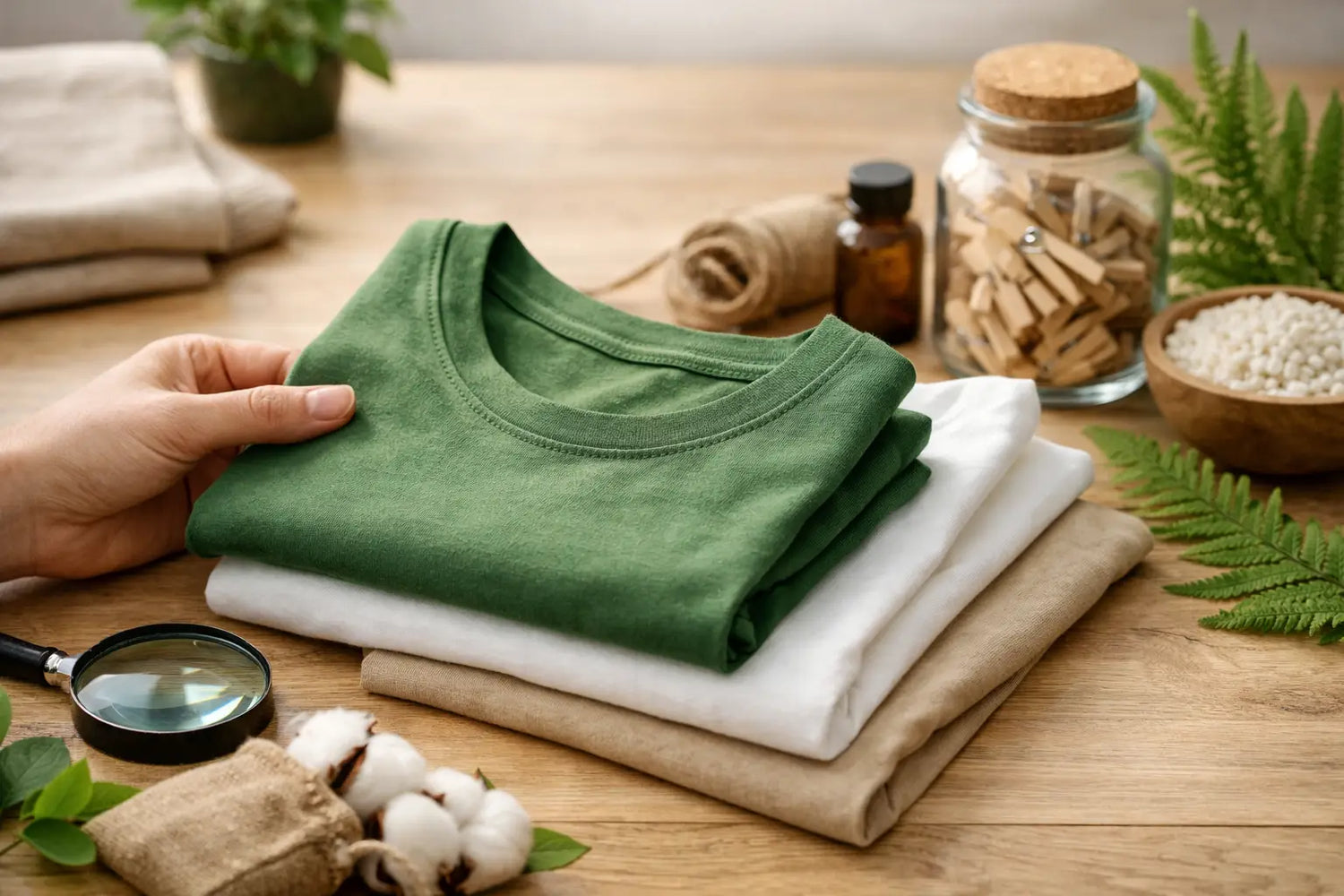
A T-shirt can look sharp and solid in a product photo, but still lose its shape after three washes. That's exactly why the question of how to recognise sustainable T-shirts is more relevant than whatever logo appears on the label. Sustainability isn't found in marketing language. It's found in fabric, construction, fit, and how long a shirt holds up in normal daily use.
How to Recognise Sustainable T-Shirts Without the Marketing Spin
You rarely recognise a sustainable T-shirt from a single claim. Not from the word premium, not from a green label alone, and not just from an organic cotton story. What matters is the full picture. Does the fabric last? Does the fit hold? Does the shirt feel sturdy without becoming stiff? And is it made to be worn often, not just to sell quickly?
For many men, it starts with a practical frustration. A shirt that stretches out at the neck. Shrinks in length. Becomes see-through. Or twists after washing. These aren't minor details. They're signals of a product that wasn't built for repeated use. A sustainable T-shirt doesn't need to be complicated, but it does need to be right.
Start With the Fabric
The fabric is the foundation. If that's not right, no amount of finishing will save the shirt. Cotton remains the logical choice for many T-shirts, but there's a difference between cotton that feels great on day one and cotton that stays strong after dozens of washes.
Longer fibres are usually a good sign. They tend to produce a smoother, stronger fabric with less pilling. You won't always see this on the label, but you'll often feel it. A better T-shirt feels compact and supple at the same time. Not paper-thin, not limp, and not excessively heavy just to seem sturdy.
Organic cotton can be a plus, but it says more about how the crop was grown than about the shirt's ultimate lifespan. That distinction matters. A sustainable shirt is only truly sustainable if you keep wearing it for a long time. Environmental gains disappear quickly if a shirt wears out early.
Blended fabrics aren't automatically worse. A small percentage of elastane, for example, can help maintain a neater fit — especially in slim fit styles. At the same time: the more complex the blend, the harder recycling becomes later. It depends on your priority — maximum shape retention or simplicity of material.
Weight Tells You Something, But Not Everything
Many people pay attention to GSM — the weight of the fabric per square metre. Rightly so, because a very lightweight jersey often feels less solid and tends to wear out faster. But heavier isn't automatically better.
A good everyday T-shirt has enough body to avoid being see-through and to drape well. But if the fabric is too heavy, the shirt can feel warm, stiff, or cumbersome — especially if you often wear it under a shirt, jumper, or jacket. Sustainability is also about wearability. A shirt that mostly stays in the wardrobe because it's uncomfortable is practically speaking not a strong purchase either.
Check the Neck, Seams, and Hem
If you want to know how to recognise sustainable T-shirts in practice, look closely. The finishing reveals a lot. The collar is often the first place where lower quality becomes visible. A neckline that already ripples or feels limp when new rarely stays neat for long.
Look at the seams too. They should be clean, even, and firm. Loose threads aren't always a disaster, but sloppy stitching is often a sign that corners were cut in production — and you'll notice that later in the shirt's lifespan.
The hem at the bottom and at the sleeves should lie flat without pulling. A shirt that already sits unevenly there can twist more quickly after washing. Shoulder seams also deserve attention. On a well-made T-shirt, they sit naturally on the body and help maintain the shape.
Fit Is Part of Sustainability
That sounds less technical, but it's true. A T-shirt that doesn't fit well gets worn less. And clothing that goes unworn is never a sustainable choice.
That's why fit is more than style. A shirt that's too wide loses its neat appearance faster. A shirt that's too tight puts constant strain on the shoulders, chest, or stomach, putting more stress on the seams and fabric. A sustainable choice also means choosing a fit that suits your body and how you use it.
For some that's slim fit, for others classic fit or long fit. Length in particular is often underestimated. A shirt that's actually too short gets pulled down constantly and loses its shape faster. A slightly longer, well-balanced fit tends to look neater in motion and after multiple washes.
Certifications Help, But Don't Replace Quality Control
Certifications can be useful. They provide guidance on material origin, chemical use, or social conditions in the supply chain. That's relevant. But a certification doesn't automatically tell you whether a T-shirt will still look good in eighteen months.
Use certifications as part of your assessment, not as the final answer. If you see a strong story about responsible materials, still check the fabric weight, finishing, and product details. Sustainability on paper and sustainability in use aren't always the same thing.
Brand Transparency Says a Lot
A brand that's genuinely committed to quality basics usually doesn't need to shout about it. You can see it in how they talk about their products. Do they clearly explain which fabric was used, how the fit works, and why a shirt lasts? Or does it stay vague with terms like conscious, eco, and premium feel?
Strong brands are usually clear about specifications. They tell you what you're buying, who a particular fit suits, and how to best care for the shirt. That's often a better signal than over-the-top campaign language. LEBASQ takes exactly that position — no fairy tales, just clothing that needs to stay good for a long time.
Pay Attention to How a Shirt Behaves After Washing
The real test begins after purchase. A sustainable T-shirt doesn't just look good in the packaging — it holds up in the routine of daily life. Wash, dry, wear, repeat. The shirt needs to handle that.
Shrinkage is an important indicator. A small amount is normal, especially with cotton. But significant shrinkage in length or width often points to less stable fabric or finishing. The same goes for twisting — when side seams start to rotate. That looks untidy quickly and is hard to straighten out.
Colour retention matters too. Black that quickly turns grey, white that looks yellowish, or a fabric that immediately goes dull loses its polished appearance. Especially with basics, that's essential. A T-shirt is often the foundation of your outfit. It needs to keep looking fresh.
Price Is a Signal, Not a Guarantee
A dirt-cheap shirt is rarely a long-term choice. Somewhere, almost always, a compromise has been made on fabric, finishing, or production. But expensive isn't automatically sustainable either. Sometimes you're paying just as much for marketing, packaging, or brand value.
Look at cost per wear instead. A shirt that costs twice as much but stays looking good four times as long is practically often the better buy — especially if you wear basics frequently. For many men, that works better than repeatedly replacing cheap shirts that don't hold their shape.
The Simple Mental Checklist
If you want to quickly assess whether a T-shirt is genuinely well-made, ask yourself a few straightforward questions. Does the fabric feel compact and pleasant? Is the neckline firm? Do the seams look tight? Is the fit logical for your body? And do you believe you'll still be happy wearing this shirt a year from now?
If doubt arises on multiple points, that's usually not without reason. With essentials, it's not about a spectacular first impression — it's about consistently performing well. Every week, again and again.
Buying Sustainably Also Means Buying Less, But Better
People searching for how to recognise sustainable T-shirts are often really looking for something simpler: fewer bad purchases. Fewer shirts that feel written off after a few months. Fewer compromises on comfort, fit, and appearance.
The best choice is usually not the shirt with the loudest claim, but the shirt that quietly convinces. Good fabric. Strong finishing. A fit that works. And a brand that understands that a basic only has value if you keep reaching for it in the wardrobe.
So don't just buy with your eyes — buy with your routine in mind. A truly sustainable T-shirt doesn't prove itself on the product page, but on a Monday morning, after lots of wearing and lots of washing, when it still just fits right.


Leave a comment
This site is protected by hCaptcha and the hCaptcha Privacy Policy and Terms of Service apply.